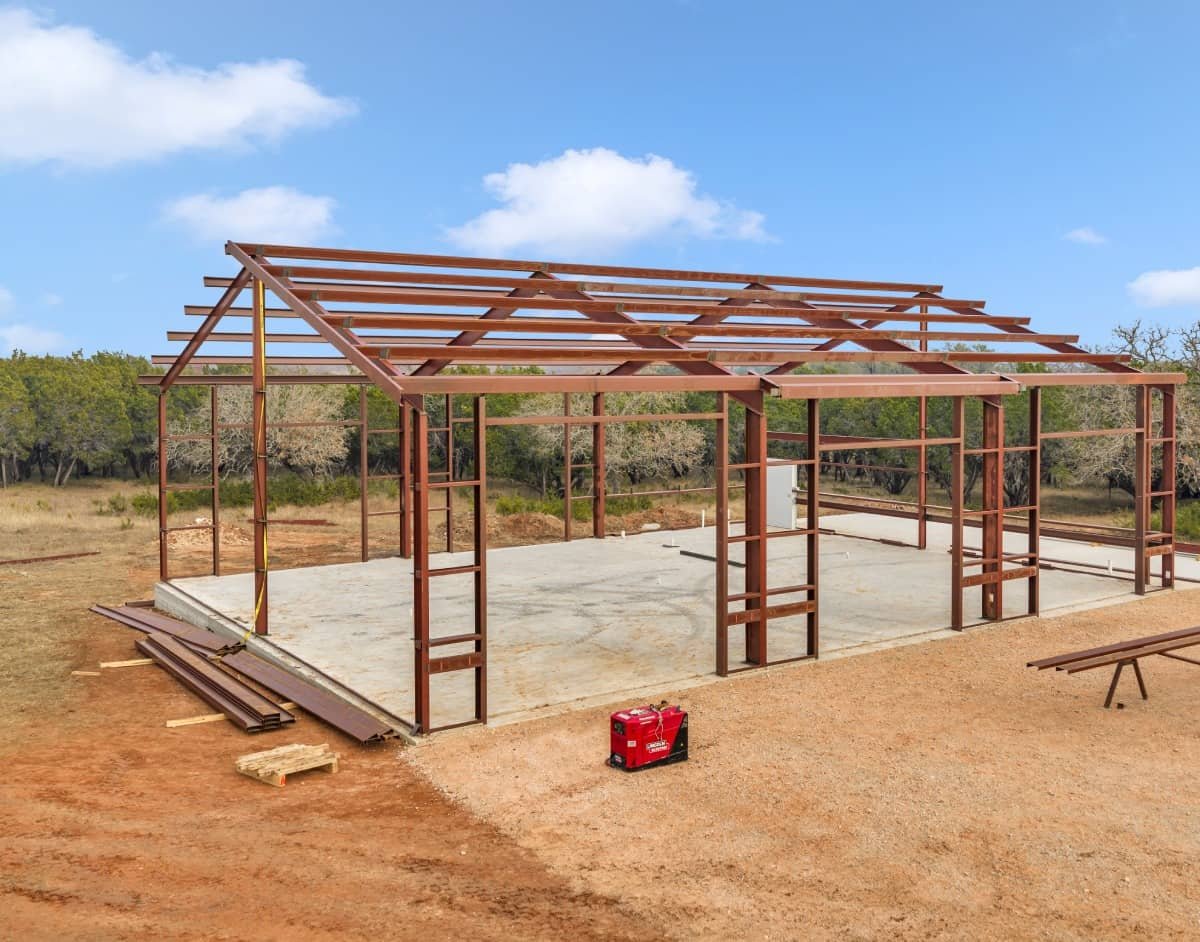
Hail-Resistant Metal Buildings in San Angelo
Hail and floodwater decide how a San Angelo owner should spec a roof and set a slab, and we start both conversations with the roof. A single-skin panel with exposed fasteners and a standing seam panel with concealed clips behave very differently when hailstones of two or three inches arrive, and the price gap between them is smaller than the cost of a repaired roof.
The city has the record to show for it. A National Weather Service summary of the May 21, 2020 hailstorm reports hail of 1.75 to 3 inches in diameter during about 90 minutes of a nearly stationary storm, with considerable damage to vehicles and roofs across much of San Angelo and the Air Force base. Water has done its own damage: the Weather Service records that in the September 1936 Concho River flood the city received 11.75 inches of rain in a day, the South Concho peaked at 111,000 cubic feet per second and the local paper reported 300 houses destroyed and 700 damaged.
We build with those facts in mind: heavier gauge roof panels where hail is a concern, finished floors set above the grade and drainage that sends water away from the footings. Then we tell you what each choice costs, so you can decide with numbers.
Shops, storage and public buildings
San Angelo's mix of customers is wide. The base employed 6,567 people directly as of 2025, including 5,516 active-duty personnel, and the Texas Comptroller estimates its affiliated population contributed at least $3.8 billion to the Texas economy that year. Numbers like that support service companies, vendors, contractors and storage users, and a self-storage facility is a common metal building near a base because a mobile population needs space.
The city and county also buy buildings. A municipal building such as a maintenance shop, a fleet barn or a storage warehouse is a natural fit for a pre-engineered frame. Public owners look for a durable roof, a good warranty and clear bidding documents, and we write proposals to meet those needs. Competitive bidding means plain numbers: we give a base price, list alternates such as insulation or a different roof panel and state what is excluded.
Roads, rivers and where to put the driveway
The TxDOT study of the San Angelo North Relief Route spans about 11 miles on a new alignment between US 87 and US 67 north of the city, with three main lanes in each direction, interchanges at US 87, US 277 and US 67 and a proposed 500-foot right of way for the potential Ports-to-Plains and I-14 corridors, with construction listed as beginning in 2032 and the schedule subject to change. For a landowner north of town, that is a long-range planning item. We would not choose a site on the assumption that a road will be built in a given year.
The more practical site questions are drainage and floodplain. Before we price a foundation, we ask whether the lot is in a mapped flood zone and what the finished floor elevation must be. A site near a river or creek may need fill, a raised slab and a drainage plan that the city has reviewed. We would rather learn that on day one than on the day of the inspection.
The 1936 flood figures are a reminder that rainfall in this country can arrive in amounts the average year never shows. A detention area, a swale along the property line and gutters that discharge away from the slab are cheap compared with a flooded shop. If you store inventory on the floor, ask us about raising the slab a few inches above the apron or setting racking on pallets above the first foot.
Building for hail, wind and a safe job site
For hail, panel gauge, profile and substrate matter. A heavier gauge, a ribbed profile and a solid deck under the roof panel resist dents better than a thin panel over insulation. Some insurers give credit for impact-rated roofs, so ask yours before you choose. Standing seam is covered on our standing seam roofing page.
On the job site, we brace each frame as it goes up, observe wind limits and stop lifting when gusts rise. Hail season can also bring sudden storms, so we secure panels, cover open bays and stage material where it cannot blow away. Crew leaders on our sites can stop work without needing permission when conditions are not safe.
What we build and what we repair
New construction is the main work: shop buildings, warehouses, equipment storage, offices and agricultural buildings. The agriculture and agribusiness page covers ranch and farm-related buildings, and the self-storage operators page covers unit-mix and door choices.
After a hailstorm, repair and replacement work follows. We inspect roofs and walls, tell you what is cosmetic and what is functional, and price panel replacement, new trim and sealing. If the frame is sound, a new roof can often be installed without disturbing operations. If you are adding space, building additions let you extend a damaged building and upgrade the roof at the same time.
The Concho Valley and neighboring cities
We serve San Angelo and the surrounding counties. Owners who also operate in Abilene or in Midland can ask us to quote several sites together, with common drawings and standards. Distance affects mobilization cost, and we show that number on the quote. Local labor helps when a storm hits many roofs at once, since crews and panels get scarce fast. If you own several buildings, a maintenance walk before storm season, with a short list of loose trim and sealant, is the cheapest insurance we know of, and we are glad to do it.
Request a San Angelo quote
Tell us the use, the size and the lot. We will respond with a price range, the roof and flood details we would recommend and a steel lead time you can plan around.
Common Questions
Is a standing seam roof worth the extra cost in hail country?
Often yes. Concealed fasteners, a heavier gauge and a seam profile that resists puncture reduce leaks and repairs, and some insurers recognize impact ratings. We price a standing seam roof against exposed-fastener panels so you can compare life-cycle cost.
How do I know if my lot floods?
Check the mapped flood zone with the city, then ask a civil engineer about local drainage. Mapped zones are a floor, not a ceiling, since local flooding can occur outside mapped areas. We set the finished floor with that information.
Can you repair a hail-damaged metal building?
Yes. We inspect the panels, trim, flashing and sealants, then replace what is damaged. If the damage is widespread, a re-skin with a heavier panel may cost less than repeated patching.
What do public owners need from a contractor?
Clear drawings, a proposal that follows the bid documents, insurance certificates and a schedule. We prepare each, and we keep a record of material submittals for the owner.
Will a metal building work for a self-storage project?
Yes. Self-storage uses repeated bays, roll-up doors and corridors, all of which suit a pre-engineered frame. We show the unit mix and door cost so you can compare layouts.