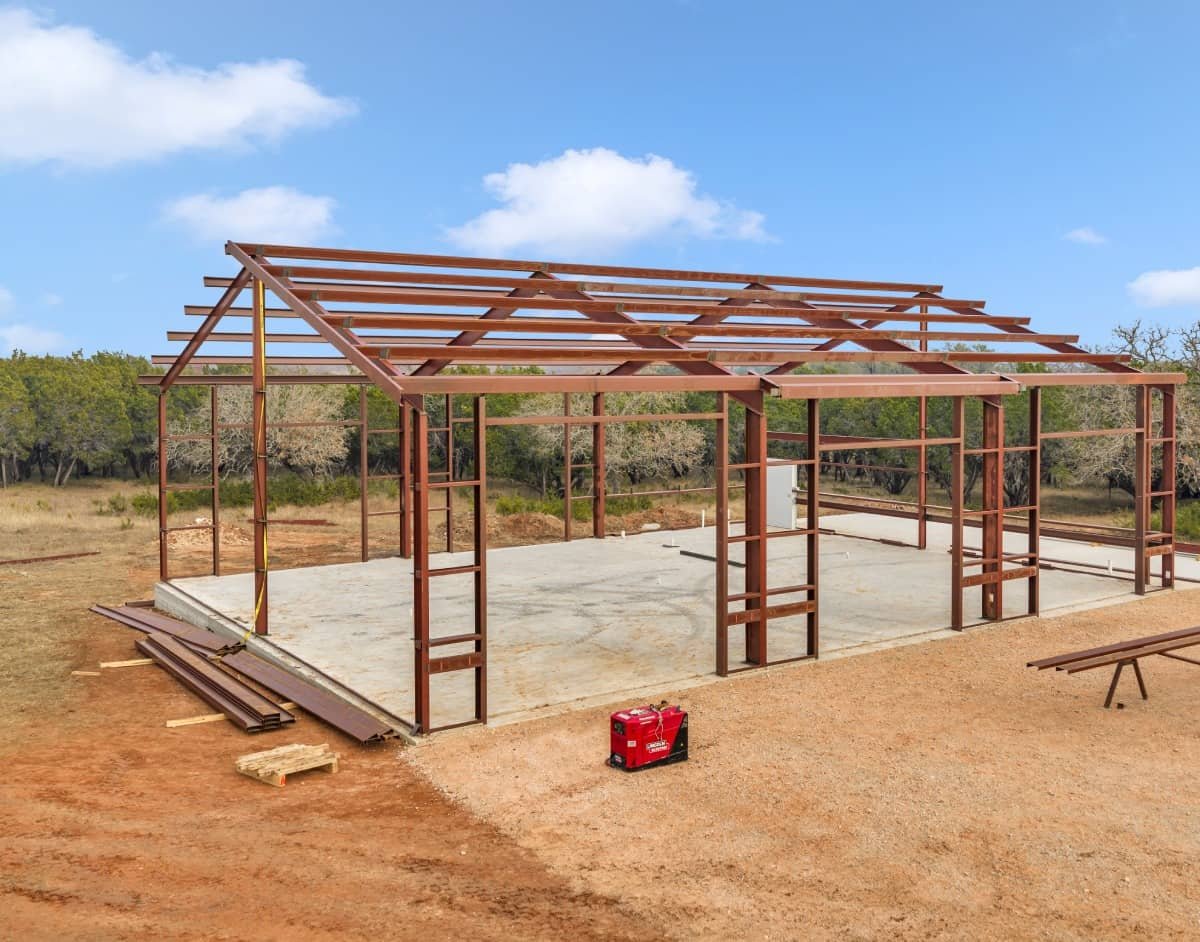
Hangars and Assembly Shells in Midland
Aerospace tenants around the Midland airport want a steel building with a column-free floor, a tall door and a slab that stays flat enough for precision work, and that is the kind of shell we erect here. The city has moved from oilfield yards toward launch, satellites and flight test, and the buildings for that work are closer to hangars and clean assembly bays than to the equipment sheds we are used to in the basin.
The announcements are large. In July 2026 the city development corporation and city council approved an incentive for a new satellite manufacturing and production facility of more than 400,000 square feet at the airport's business park, with $100 million in taxable investment through 2034 and 1,800 full-time positions at full build-out. In September 2024 the council approved an agreement under which a space-flight company will bring $78 million in assets to Midland by 2027, using a development-corporation-owned hangar at the same park.
We will not claim any of that work. What we do is erect the buildings that surround it: hangars for flight-test support, assembly shells, supplier shops, warehouses and offices. Those buildings need to be ready quickly, and they need a price that makes sense for a tenant who may be on a ground lease.
Ground leases, seismic activity and highway work
Midland International Air and Space Port calls itself the first commercial spaceport sharing a site with an FAA Part 139 commercial airport. Phase 1 of its Spaceport Business Park covers 50 acres on the airport's southeast side and is offered on ground leases negotiated by the development corporation. A ground lease changes how a building is financed and what happens to it at the end, so we design with removal or sale in mind: bolted connections, standard bays and no unusual foundations.
The region has another site condition. The Railroad Commission reported six felt earthquakes of magnitude 3.5 or greater from February 2020 through September 2021 in the Gardendale Seismic Response Area, including a 3.7 about eight miles northwest of Midland, and later enlarged the area after a magnitude 5.4 event in December 2022. Metal buildings are light and flexible, but anchor bolts, base plates and bracing should be designed by the engineer for the seismic category the code assigns to your site, and we build to that design.
Roads and rail of the Permian trade
Highway work shapes access. TxDOT posted a notice in June 2024 proposing Loop 250 main lanes in Midland County between Fairgrounds Road and Elkins Road, with an overpass at Todd Drive. A 2019 public meeting covered improvements to the I-20 corridor between Loop 250 and FM 1788 with a new interchange at County Road 1250 to improve access to the industrialized area it serves. For a buyer, a proposal is not a built road. We check which projects have been funded before we recommend a driveway location.
The Permian Basin itself is a large neighbor, and our Permian Basin page describes the oilfield side. Nearby Odessa shares labor and suppliers with Midland, and many owners compare the two before choosing a site.
Think about labor and delivery too. A tenant that arrives with a payroll of hundreds needs parking, restrooms, a break area and a shipping door for crates, none of which are exciting but all of which take space in the plan. We lay those out with the tenant before we freeze the frame, because it is much cheaper to add a lean-to for shipping and receiving in the drawings than to bolt one on after the walls are up.
Hangars, plants and yard buildings
Three kinds of building fill our Midland calendar. A hangar needs a wide door opening, a clear span and a slab that drains. A light plant or assembly shell, which falls under manufacturing plant work, needs power, clear height and sometimes a bridge crane. A yard building, such as a maintenance bay, needs doors, drains and rugged finishes.
Where cranes are involved, the frame gets heavier columns and a runway beam, as described on our high-bay crane-ready buildings page. We recommend deciding about crane capacity before the steel is ordered, because the frame changes.
Safe erection in open West Texas country
Wide open terrain means wind. We follow wind limits for lifting frames and panels, brace each bay as it goes up and secure loose material at the end of the day. We also plan for heat: shaded rest areas, water and a work schedule that moves heavy tasks to the cooler hours.
For aviation sites, the airport adds rules. Crane height may need approval near the runway, vehicle access may be restricted and badging may be required. We ask your airport contact for those rules at the start, so that crane placement and deliveries are approved before we mobilize.
A building that suits a short lease or a long one
We keep the building simple. Standard bay spacing, a standard roof slope and proven details make the frame cheaper to fabricate and easier to modify. If a tenant needs special features such as a tall door, a thicker slab section or a heavy equipment pad, we engineer those parts and keep the rest standard.
That approach helps in a market where tenants may change. When one user moves out, the next can use the building with minor changes. For aviation-related users, our aviation industry page covers more about door types and fire protection, and the manufacturing page does the same for production shells.
Finally, we stay candid about what a pre-engineered building cannot do. It will not make a cleanroom, and it will not replace a purpose-built test stand. It will give your operation a fast, dry, well-lit enclosure at a price you can plan around, with the structural details engineered and stamped, so that the specialized trades can start work sooner.
Get a Midland hangar or plant quote
Describe the aircraft or the product, the lease or lot and the date you need it. We will respond with a range per square foot, a steel lead time and the site-condition questions that could move the number.
Common Questions
Can a metal building be used for rocket or satellite work?
A metal building can enclose the space, but the process equipment, cleanrooms and special systems are designed by the user. We build the shell, slab, doors and basic services, and coordinate with the user's engineers on loads, openings and clearances.
How should I think about earthquake risk?
The structural engineer designs the frame, base plates and anchor bolts to the seismic category the code assigns to your site. Regional earthquakes have been reported by the Railroad Commission, so ask for the seismic criteria on the stamped drawings and make sure the foundation matches them.
What changes if I build on a ground lease?
The building has to meet the lessor's design rules, and its value at the end of the lease may be limited. We design for removal or reuse and keep the foundation conventional. Read the lease before you start drawings.
Do I need the airport's approval for a crane?
Near an active airport, usually yes. Cranes can be obstructions to flight paths, so the operator and sometimes the FAA review them. We ask for the airport's rules at the beginning of the project.
How big can a clear-span hangar be?
Large spans are possible with deeper steel. The cost climbs with span and door height, and the frame gets heavier. We compare options for your aircraft so you can see the cost of each additional foot.