Data Center Shell and Support Buildings in Texas
About 474 gigawatts of interconnection requests are waiting in the state's grid queue, roughly 90 percent of them for data centers, according to a letter from the governor reported in August 2026. That one number explains why a data center project in Texas starts with the power study and not the building. We are a metal building contractor, so we say plainly where a pre-engineered building fits in this market and where it does not.
A hyperscale campus is usually built with precast, tilt-up or heavy structural steel and a long list of specialty trades. Where a metal building makes sense is the part of the market that is smaller, faster and more modular: edge sites, colocation shells, powered shells for a later fit-out, generator and switchgear enclosures, and equipment buildings on the edge of a larger campus. In those roles, a clear span frame with an insulated envelope is a fair match for the job.
Below is how we approach those buildings and the questions a Texas owner should settle before signing.
Power rules and politics shape the schedule
Texas Senate Bill 6 directs the Public Utility Commission to adopt interconnection standards for large loads in ERCOT, with a threshold of 75 megawatts or lower. Large loads must show site control, pay a study fee of at least $100,000, meet financial commitment requirements, and those connected at transmission voltage after the end of 2025 must install equipment that lets them be curtailed during a load shed. In August 2026 the governor called for a moratorium on new data center interconnections and a community impact review of data centers and crypto facilities of 25 megawatts and above, and ERCOT said it would miss an April 2027 deadline for its Batch Zero study.
Rules like these are changing, and we do not pretend to give legal advice about them. What we tell owners is simple: confirm your interconnection status before you commit to a building contract, and write the contract so the building schedule follows the power schedule. We would rather hold a steel order than erect a shell that waits two years for service.
Sites we see and what they imply
Large announced projects give a sense of scale. Meta announced a data center in northeast El Paso of about 1.2 million square feet on roughly 1,039 acres, reported at more than $1.5 billion with a planned 1 gigawatt of eventual capacity and a 2028 online date. In Taylor, an 87.97 acre tract is slated for a 135,000 square foot data center. In Abilene, secondary-source reporting describes a large AI campus among the city's biggest employers, which we word cautiously because the figures should be checked with the operators.
The lesson for a smaller owner is that land, water, fiber and power are all bundled into the site decision. We pick the work up once those are secured, whether the site looks like El Paso, Taylor or Abilene, and we build the shell, the generator yard and the support buildings on a calendar that matches utility commitments.
Where a metal building fits inside a data center project
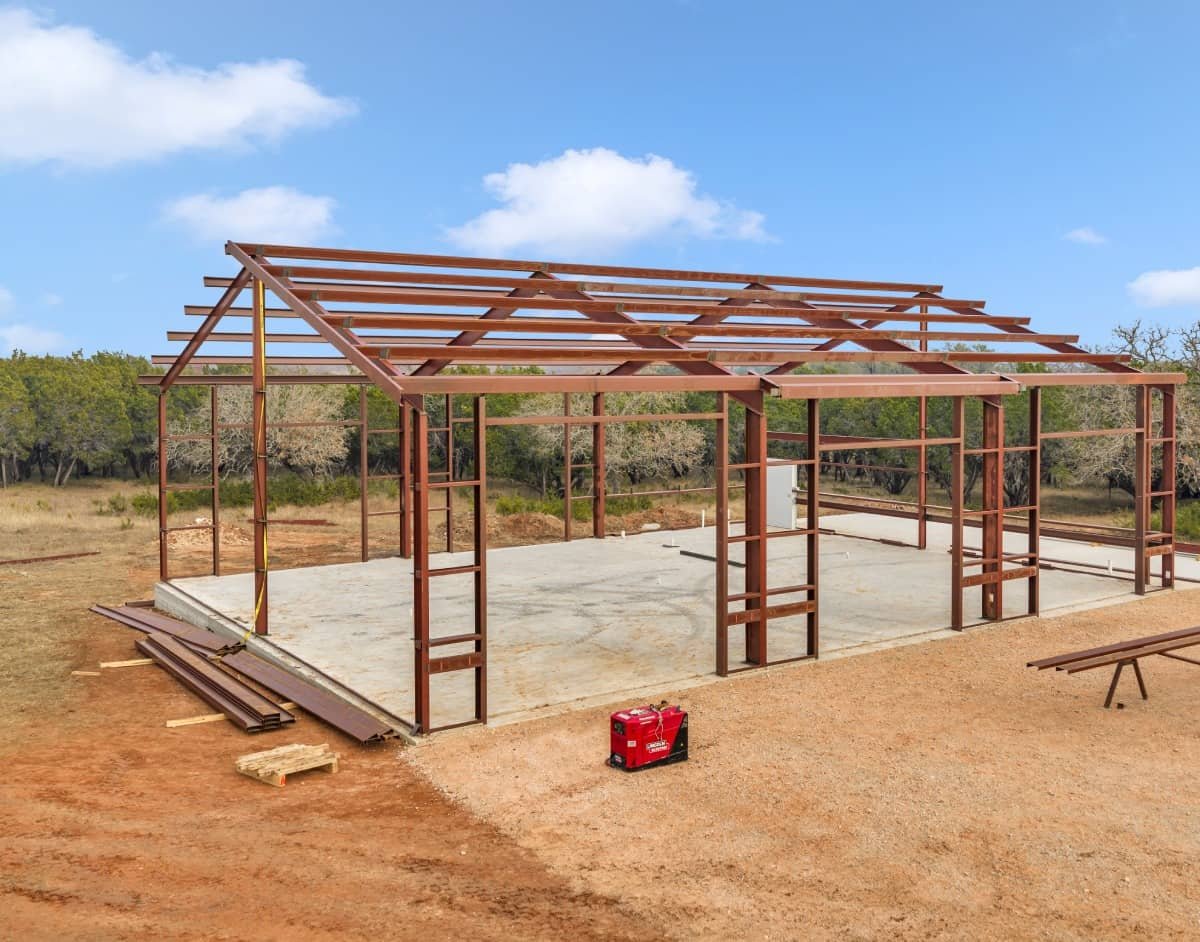
A clear span frame can hold a data hall with no interior columns, which gives the fit-out contractor freedom to place racks, cooling and containment. The envelope keeps weather out, and insulation and a vapor barrier protect conditioned space. We frame for heavy roof loads, because rooftop cooling units, cable trays and sometimes solar or battery equipment add weight. Our design-build process lets the structural engineer, the owner's mechanical engineer and our steel detailer settle those loads together.
Beyond the data hall, a campus needs generator pads and enclosures, a security building, a loading dock for equipment, a maintenance shop and storage. Those are all natural pre-engineered buildings. We also erect heavy members for gantry cranes and equipment supports through the structural steel erection crews we coordinate. Compare this with a tilt wall building for the data hall itself, which some owners prefer for security and mass.
A realistic calendar for a shell
A powered shell can go from approved drawings to a weathertight building in a matter of months, with the slab, steel and panels in sequence. The long items are utility service, switchgear and generators, and they run on the supply chain and the utility's calendar, not ours. We write the schedule with those items as separate lines and mark which ones belong to the owner.
We also plan for access control. Data center sites usually need secure perimeters, badge access for subcontractor crews, and background checks. Add days to a calendar for crew onboarding. Delivery of large equipment needs a heavy haul route, and we survey that early.
What the shell costs and what it does not
The building is a small share of the total data center cost. Electrical, mechanical and IT equipment dominate. The shell is where an owner can save money and time, but only if it is not overbuilt. Clear height, floor loading, roof load, fire rating, security features and envelope tightness are the drivers on our side. We give a dollars per square foot figure for the shell and list exactly what is included, so you can compare it with a precast or tilt quote on a like-for-like basis.
Municipal and public works owners, a group we serve through municipal and public works projects, are often the ones asked to approve water, drainage and road work around these campuses.
Tell us your power status and the building you need
Share the site, the megawatts and the stage of utility approval. We will tell you whether a metal building fits, what it would cost per square foot, and what dates depend on the utility.
Common Questions
Can a pre-engineered building hold a data hall?
Yes, for the right size and load. A clear span frame gives open floor space, and roof framing can be designed for cooling equipment. Very large halls with heavy security needs may be better in concrete. We tell you which direction fits your project.
What should I settle with the utility before I order steel?
Settle your load request, study status and energization date. Large loads now face study fees, financial commitments and, at transmission voltage, curtailment equipment. We write contracts so steel release follows a confirmed power path.
Will the moratorium talk affect my project?
It may. The governor called for a pause on new data center interconnections in August 2026, and the grid operator has said it will miss a study deadline. We cannot predict outcomes. If your project is below the size thresholds under discussion, ask your utility directly.
Do you build the generator yard and support buildings?
Yes. Generator enclosures, security buildings, shops and storage fit our work. We coordinate foundations and conduit paths with the electrical contractor so the pads are in the right place the first time.
How is a data center shell different from a warehouse?
It is built to tighter tolerances. Roof loads are heavier, the envelope has to be air-tight, and floors carry racks and cooling equipment. Security and fire design add cost. See our pre-engineered metal building page for the basic system.