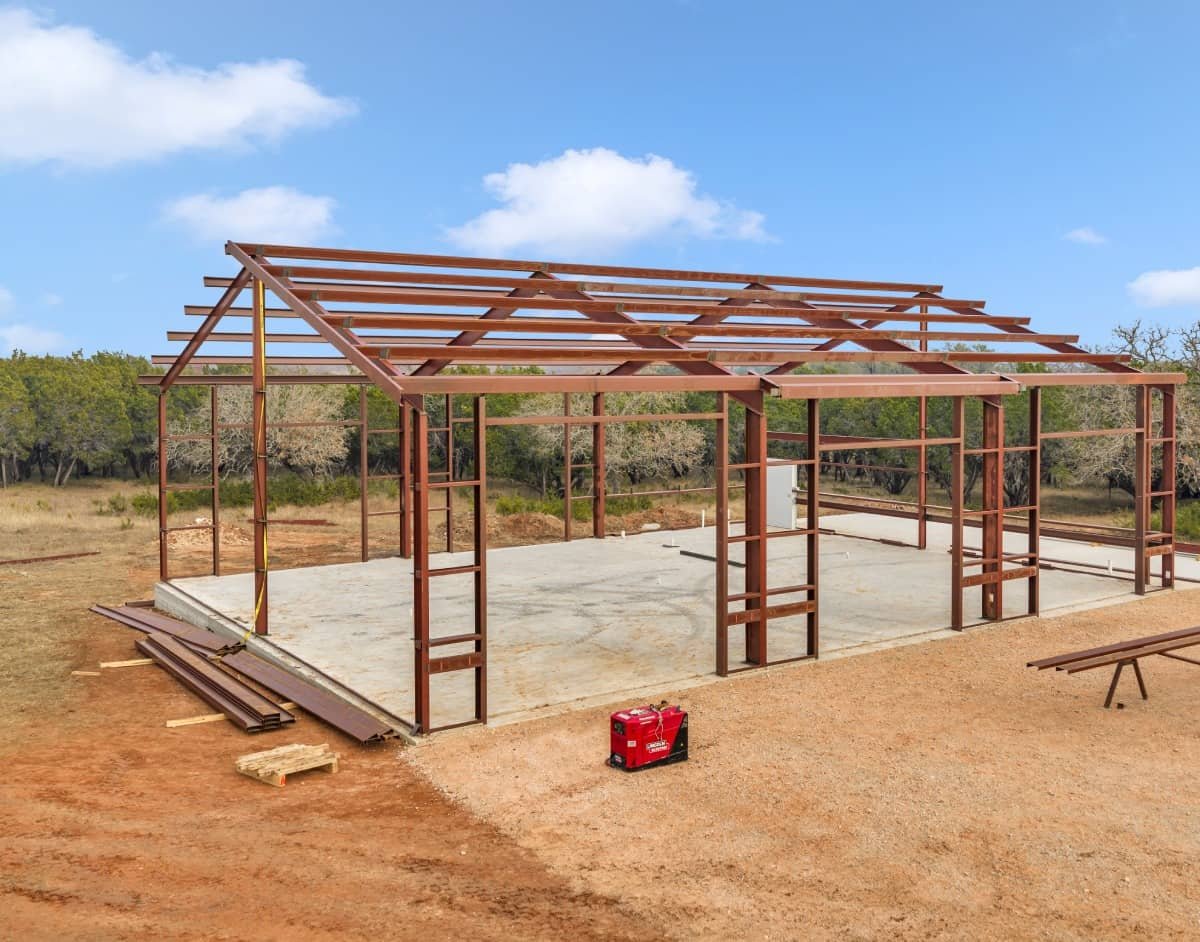
Metal Buildings in Taylor, Texas
When a very large semiconductor plant breaks ground in your town, the buildings that matter next are small, quick and close by: a laydown yard under a roof, a contractor shop, a tool crib, a vendor warehouse. That is the work we pursue in Taylor. We erect pre-engineered steel buildings for the trades, suppliers and service companies that follow a big project, and we do it at a firm price per square foot with the lead time on steel written down.
Taylor is about 29 miles northeast of Austin, in Williamson County. A chipmaker announced a US$17 billion semiconductor plant near the city in November 2021, expected to employ 2,000 people, and the record says limited operations began in 2025 while construction continued. We do not build the plant. We see what surrounds it: crews that need a staging shop, vendors who need a warehouse, and landowners who see an opportunity.
A steel building suits that moment because it is quick. Your contract date is not going to wait. We give you a package price, a site number and a steel delivery date so you can decide whether to build or lease. Many owners in this position are not experienced builders, and we do not expect them to be. We explain each line, the order of work and who handles which permit. If the numbers do not work, we tell you before you spend money on drawings.
Employers, a grid operator and a blackland setting
The city's largest employers include the state grid operator, two manufacturers and a residential facility. That mix is less about trades than about office, light manufacturing and operations space. The manufacturing side of town matters here. Light manufacturers in particular want a shell with a strong slab and a good crane or hoist rating, which is the territory of our crane industrial buildings work.
Taylor sits over blackland prairie, the same soil type found at Hutto. That soil is rich farmland and a hard base for a building. The expansive clay moves with moisture, and a state research report on how to calculate vertical rise is the sort of reference an engineer uses. We call for a geotechnical report on every Taylor project before final foundation drawings.
Buildings that follow a big project
We have a simple rule in a boom market: build what you can use, not what you hope to rent. The first wave is practical. Contractor shops with a 16 foot eave and two overhead doors. A tool and equipment building with a fenced yard. A parts warehouse with a dock. Our flex and light industrial page covers the layout. A small yard with a shop, a gate and room to park six trucks is often better than a larger building the owner cannot fill. Second-wave buyers are suppliers: calibration, cleaning, packaging, gas handling, trucking and maintenance firms that serve a plant.
The third group is larger. According to the record, a 135,000-square-foot data center is planned on an 87.97-acre tract in Taylor, land that was donated in 1999 for $10 and later sold for $10 million. A data center is not a pre-engineered metal building in the usual sense, and we do not claim it is. But supporting buildings for utility, storage and maintenance, such as those described under data center work, can be steel.
Moving at the speed of a project schedule
In a market with large projects, labor and materials get tight, and crews that were available last quarter may not be this one. That affects concrete, rebar, erection labor and delivery trucks as much as steel. We plan the schedule with the crews we will actually use and confirm dates with them before we commit to yours. When something slips, we tell you what moved and what it does to the finish date. Our answer is to order steel early, hold a fabrication slot and keep the foundation moving while the frame is in the shop. Once the slab is cured and the anchor bolts are verified, erection takes days.
We give you a written lead time on steel and tell you if it shifts. If you are a trade contractor with a start date, tell us the date, and we will work backward from it to the order date.
Where a Taylor shop budget goes
The building package, foundation and site work are the three buckets. The package is predictable. The foundation depends on the clay. Site work depends on whether the lot has a driveway, utilities and drainage. A lot next to the highway typically has utilities nearby, while a farm-road lot may need a long extension.
A lot with a wide front is cheaper to serve than a narrow, deep one, because driveways and utilities run shorter. Owners who buy acreage on the edge of town for a yard should also think about road access for heavy trucks. Insulation and doors are the next tier. Taylor summers are hot, and an uninsulated metal shop is rough to work in. Even a simple ceiling blanket and a ridge vent help. We show the options with costs, and you pick.
Design-build and fast turnarounds
Many Taylor buyers want one contract, one number and one schedule. That is design-build, and it saves weeks compared to hiring a designer, then bidding to a contractor. If you want to start small and grow, plan a building expansion into the original frame.
Nearby, the larger Austin-area market is described on our Austin page, and the next town north on the corridor is covered on the Georgetown page.
Get a Taylor building schedule and price
Tell us what the building is for and when you need it. We will return a package price, a site estimate and the steel delivery date.
Common Questions
Can a small contractor justify a metal shop in Taylor?
Often yes, if the work is steady. A 40 by 60 foot shop costs a fraction of a larger commercial building and can be paid off over time. Compare it to your current rent. We also frame for a future extension, so you do not outgrow it.
How does blackland clay affect my building?
The clay swells in wet weather and shrinks in dry. The slab and footings are designed with that in mind, using a geotechnical report. It adds cost to the foundation, not to the steel.
Do you build data center support buildings?
We build steel shells for storage, maintenance and utility support. Data halls themselves have separate structural, cooling and power requirements beyond a standard pre-engineered building, and electrical interconnection rules for large loads are set by state law and the grid operator.
How fast can I get a building up?
The long item is usually the steel package. After that, erection moves quickly. We give a written lead time and update it if the mill or fabricator moves.
What happens if the plant schedule changes and my work slows down?
A steel building keeps its value because it can be reused. A shop built for one vendor relationship can be rented to another trade, and an end wall built for expansion can also be sold off. We frame buildings with a generic layout, wide doors and clean floors, so the next tenant can use them. That is a safer bet than a building tied to a single customer, and it gives you something to fall back on if a contract ends early.
Do you handle yard and fencing too?
We can coordinate paving, fencing and gates with the building, or you can have your own civil contractor do it. We tell you what the building needs for truck access and drainage.