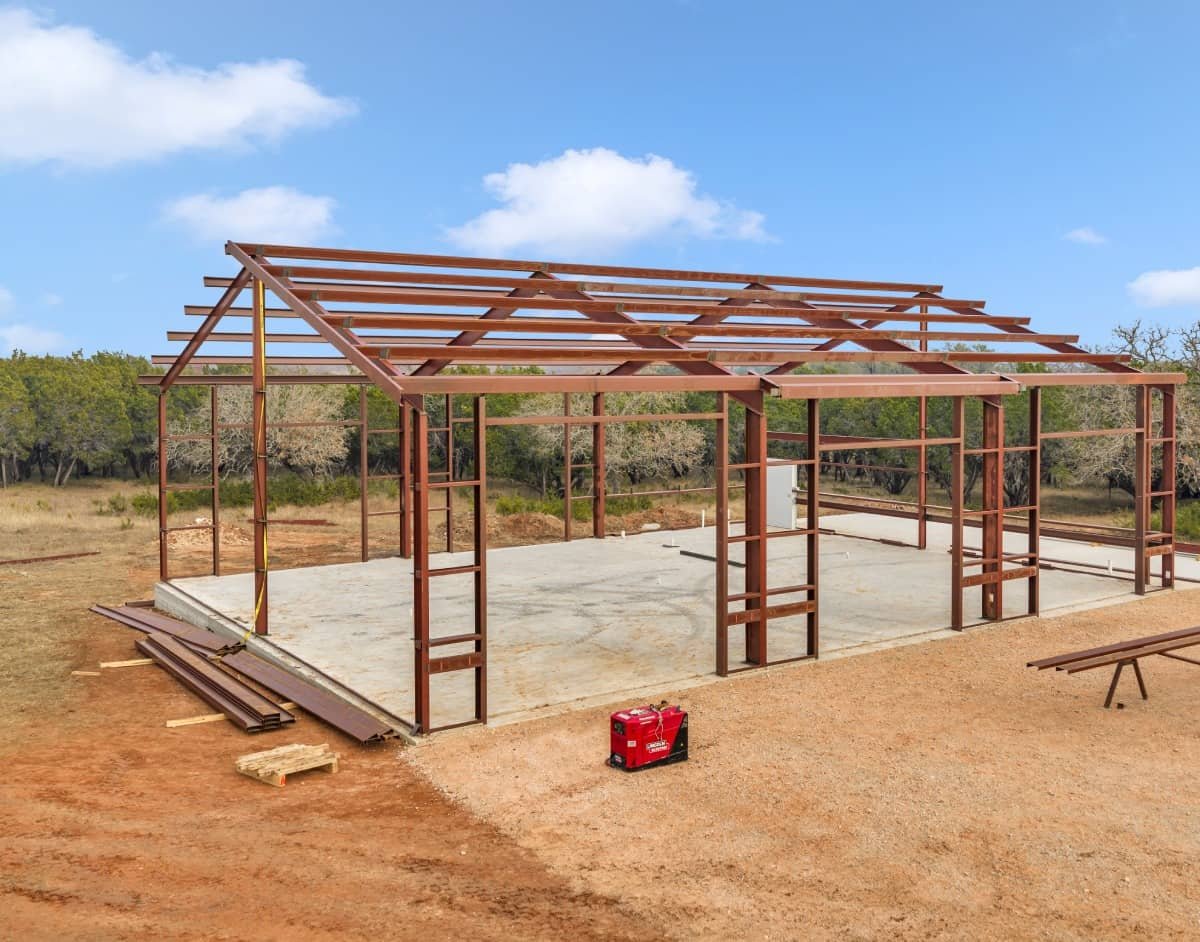
Metal Buildings in San Antonio, Texas
A metal building north of San Antonio can be stopped by a map before anything else, because an aquifer review may come before the building permit, and we plan the schedule around that. We erect pre-engineered steel shops, warehouses, aviation support buildings and supplier facilities across Bexar County and the surrounding area, with the foundation, frame, panels and finish handled together and the permit path described before you commit.
The Texas Commission on Environmental Quality states that before building on the recharge, transition or contributing zones of the Edwards Aquifer, a plan must first be reviewed and approved by its Edwards Aquifer Protection Program under 30 TAC Chapter 213, and that technical review of an administratively complete application takes 90 days. For an owner, that sentence is a schedule item: three months of review, on top of the city permit, if your lot lies in a regulated zone. We check the lot against the zone map in the first week and tell you whether the review applies.
Building the calendar backward from occupancy
A San Antonio schedule has more steps than most. If the lot is in a regulated zone, the aquifer plan goes first. The city permit comes next, then steel release, foundation and erection. Some steps overlap: the metal building drawings can be developed while the aquifer review runs, and the steel can be fabricated while the foundation is cured. We lay the overlap out in a simple chart.
The most useful decision you can make is early, even if it is only to hire an engineer to prepare the aquifer plan. A complete application avoids an administrative-completeness delay, and a prepared engineer can answer questions in days rather than weeks. Ask for these numbers early, since the footprint of the roof and the paving drives the design of any water-quality feature. We work with your civil engineer and share the building footprint and impervious cover numbers so the plan matches the drawings.
Services that suit aerospace and supplier users
Many San Antonio owners want more than a bare building. We offer aircraft hangar construction for aviation users, industrial office buildouts to finish the front of a supplier shop, and insulated metal panels where temperature or noise control matters. Each is planned into the frame, not retrofitted.
For aviation work, door height and width and floor flatness set the design. For suppliers, dock position, clear height and crane capacity are the main items. We ask for the biggest item you handle and design the building around it.
Aviation, vehicles and logistics
A September 19, 2025 KSAT report says Port San Antonio covers 1,900 acres on the city's West Side, provides nearly 18,000 jobs directly (83,766 including indirect employment) and brought $20 billion to the Texas economy the prior year, with aircraft maintenance operators on site. A Port San Antonio page summarizing a November 2016 Texas Comptroller study describes the campus as accessible by air, rail and truck, with an industrial airport at Kelly Field and an East Kelly Railport that supports energy, construction, manufacturing and retail, and says less than half of the acreage had been developed at that time.
We serve aviation businesses and automotive and fleet suppliers, along with manufacturing firms that sell to either. Each wants a clean, flexible building close to a major corridor.
Permits beyond the aquifer
Even outside the aquifer zones, San Antonio permitting has its own steps: plans submitted to the city, review comments, resubmittal, and inspections during construction. The city applies its own local amendments, and the state accessibility program applies to larger projects. We confirm the governing requirements in writing before the metal building engineer starts, since they set wind, framing and energy provisions.
We also look at height and lighting rules near the airports, utility easements and drainage. A site plan that handles those from the start avoids redesign.
Supplier demand around a growing plant
Fox San Antonio reported that on July 6, 2026 an automaker announced a $3.6 billion expansion of its San Antonio plant, adding a second vehicle assembly line, creating 2,000 jobs and adding 2.5 million square feet, which would make the plant twice its current size by 2030. The report adds that the company has invested $8.3 billion in San Antonio over the past two decades. We cannot predict how a supplier will respond, but growth on that scale usually draws tier suppliers, logistics operators and service companies who want space within a short drive.
Texas Public Radio reported on March 18, 2025 that the Port San Antonio board approved more than $7 million to finish design of an Innovation Tower office project aimed at aerospace and defense companies, and that the Port's existing space totals 10 million square feet at more than 97 percent occupancy. High occupancy leaves owners with fewer rental choices, and some decide to build instead. Steel suits owner-users who want 10,000 to 60,000 square feet on their own parcel.
Rock, clay and runoff
San Antonio soils vary from shallow limestone to expansive clay, sometimes within a single block. A geotechnical report tells us which foundation to use: drilled piers, spread footings or a stiffened slab. Limestone can make drilled piers slower and costlier, while clay can lift a slab if drainage is poor. We follow the report.
Runoff is the other issue. In the aquifer zones, stormwater controls and impervious cover limits are part of the plan, and in all zones, drainage should lead water away from the building. A roof is an impervious surface, so a bigger building can mean a larger detention or treatment feature, and we raise that early. San Antonio is also where many oilfield service companies keep their headquarters; if yours runs yards in the Eagle Ford shale belt, we can design a headquarters shop and a field yard as a matched pair. Owners who also serve the coast compare these sites with Corpus Christi, which is a different permit, wind and flood picture altogether.
Check your San Antonio lot
Send us the address and the use. We will tell you whether aquifer review applies, outline the permit path and return a priced building scope.
Common Questions
How do I know if my lot is over the Edwards Aquifer?
Check the TCEQ zone maps or ask an engineer to confirm the recharge, transition and contributing zones. We do an early check as part of site review. If the lot is regulated, the plan must be approved before construction begins.
How long does the aquifer review take?
The agency states that technical review of an administratively complete application takes 90 days. Incomplete applications take longer, so a thorough submittal matters.
Can the building design start while the review runs?
Yes, within limits. We can prepare the metal building drawings and release steel fabrication after the permit path is clear. We never start earthwork before approval where approval is required.
Is steel suitable for an aviation support building?
Yes. Hangars and aviation shops are commonly built with clear-span steel frames and large doors. Airport rules on height and lighting may apply.
What size building do suppliers usually build?
Many choose between 10,000 and 60,000 square feet with dock doors and an office. We start with your equipment and storage needs.