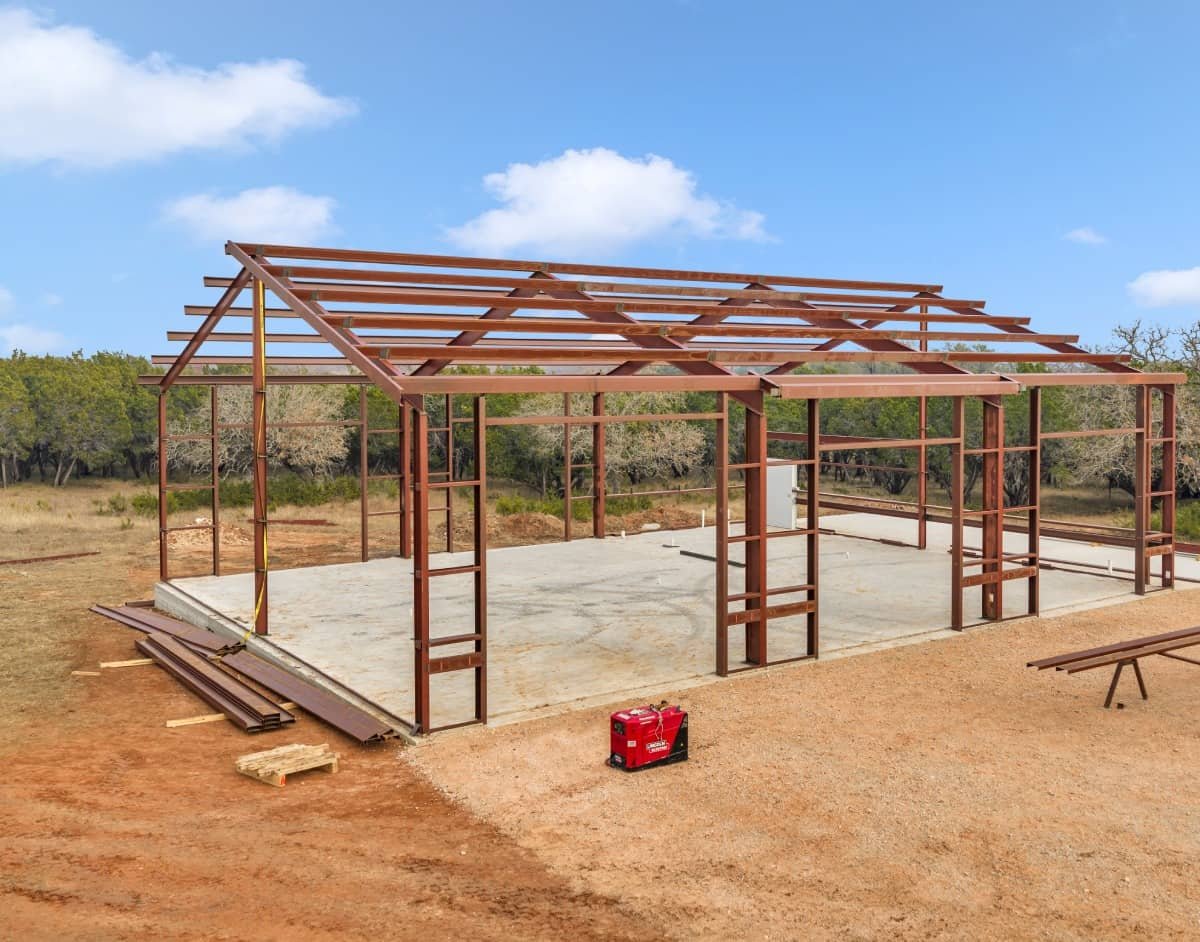
Metal Buildings in the Eagle Ford Shale Belt
An oilfield service yard in the Eagle Ford needs a shop it can afford in a slow year and still use in a busy one, and pre-engineered steel is built for that. We put up equipment shops, parts warehouses, field offices and covered storage across the Eagle Ford counties, with pricing per square foot, a stated steel lead time and a design that can be expanded, dismantled or sold if the activity map changes.
The Dallas Fed describes the Eagle Ford Shale as an arc across 20,000 square miles in South Texas, with Energy Information Administration boundaries spanning a 23-county region, and says the first Eagle Ford well was completed in October 2008. It reports that in the fourth quarter of 2024 Eagle Ford counties produced about 1.2 million barrels of oil per day, roughly 6 percent of U.S. oil output, and about 7 billion cubic feet of natural gas per day. That is a large, long-lived field, and the equipment yards that serve it are spread over many counties rather than clustered in one city.
Yard buildings that do real work
A typical service yard needs a main shop with two or three bays, a parts room, a wash bay, an office and a covered area for equipment. The shop frame is a clear span of 50 to 80 feet with a 20-foot eave so a tall truck or a mast can pull inside. We set the slab for heavy axle loads and specify a floor drain and oil separator where the yard needs them.
Ranch-style sites bring their own details. The building might sit on a caliche pad, a clay slope or sandy soil, and the geotechnical report tells us which foundation to use. Power is often the real constraint in the field, so ask the utility about service size early. Gates, fencing and lighting matter as much as the building for a yard with expensive equipment, so we coordinate them with the building plan. Security cameras, perimeter lights and a lockable tool room belong in the first drawing, because theft is a standing concern at remote yards and the cheapest time to wire for them is before the walls close.
Designing for boom and bust
The Dallas Fed reports that Eagle Ford counties had about 399,000 jobs in the fourth quarter of 2024, that 41 rigs operated in those counties in the fourth quarter of 2025 (down 13 percent from a year earlier), and that the rig count rose from 30 in June 2009 to 312 in June 2012. Those swings are the reason steel buildings are common in the field. A building that can be erected quickly, expanded as work grows and disassembled if it does not has a different risk profile than a masonry building.
We help you decide how much to spend now. A smaller first phase with a plan for later bays is often the right move. Insulation, a finished office and a mezzanine can be added once cash flow is clear. We price those options individually so the base building stays affordable.
Crews that go where the work is
We manage the erection and travel to the site. For remote yards, that means planning a full erection run: materials staged, equipment available, and crew accommodations arranged. We ask you about the nearest fuel, water and power so we can plan around them. If the site is far from a town, we bring what we need rather than losing days on supply trips.
Our agricultural building experience helps here, since many field sites resemble ranch property: open land, long gravel roads and no neighbors. We build for that environment with strong foundations, simple details and weather-resistant finishes.
Energy services, ranches and county work
Our customers include equipment dealers, trucking companies, inspection firms and welding shops that support the field, and ranchers and landowners who need barns and storage. County governments also need shops and storage for road equipment, which is part of our municipal and public works work. Each group wants a building that is simple, tough and ready on time.
The Texas Association of Counties magazine reported in 2026 that De Witt County maintains 690 miles of county roads, has appropriated $23 million a year for several years for road and bridge work, has spent at least $220 million on reconstruction and maintenance since the boom began, and that repairs can cost as much as $1 million per mile. Heavy truck traffic wears roads quickly. Counties and operators both need nearby shops to keep equipment working.
Remote sites and heavy weather
Remote sites change the safety plan. Emergency response is farther away, so we bring first-aid supplies, communication equipment and a clear address and map for responders. Heat is a hazard in summer, so crews drink water, rotate and start early. Lightning and wind end the day when they arrive.
We keep heavy equipment on firm ground, avoid crane operations near power lines and walk the site for hazards such as old wellheads, buried lines and fence crossings before we mobilize.
Add-ons that suit field facilities
Many Eagle Ford owners add a mezzanine for records and a break area, a set of overhead doors in oversize openings, and insulated metal panels for the office and parts room. These change the frame, the foundation and sometimes the permit, so we settle them in design.
If a yard grows, building additions are straightforward when the end wall was designed to open.
Karnes, De Witt, La Salle, Webb and neighbors
The Dallas Fed says Karnes, De Witt and La Salle counties produced 46 percent of the oil in the fourth quarter of 2024 and that Webb County was the largest gas producer at about 3 billion cubic feet per day. We build in those counties and the others along the belt. Many service companies are headquartered in San Antonio and run yards out in the field, and we can match the main office and the yard to the same design family. Operators who want a yard nearer the coast also look at Victoria and Corpus Christi.
Plan an Eagle Ford yard building
Send us the county, the equipment list and how you expect the work to change. We will propose a phase plan and a steel lead time.
Common Questions
Can a steel building be moved if the work moves?
It can be dismantled and reused, though cladding and trim often need replacement. A bolted frame is designed to come apart. We discuss that in design so the details help instead of hinder.
What do you need to know about my remote site?
We need the address, the access road, the soil conditions and utility availability. A site visit or photos help. We also ask about local rules and landowner requirements.
How should I size the first phase?
Size it for the work you have under contract plus a modest cushion. Leave a plan for the next bays. Steel makes it simple to add them.
Do road conditions affect steel delivery?
Yes. Heavy loads on rough county roads cause delays and sometimes damage. We scout routes and schedule deliveries around wet weather and road restrictions.
Can you build a wash bay and oil separator?
We coordinate the slab, drains and separator with your civil engineer or contractor. The building provides the enclosure; the drainage system follows local environmental rules.