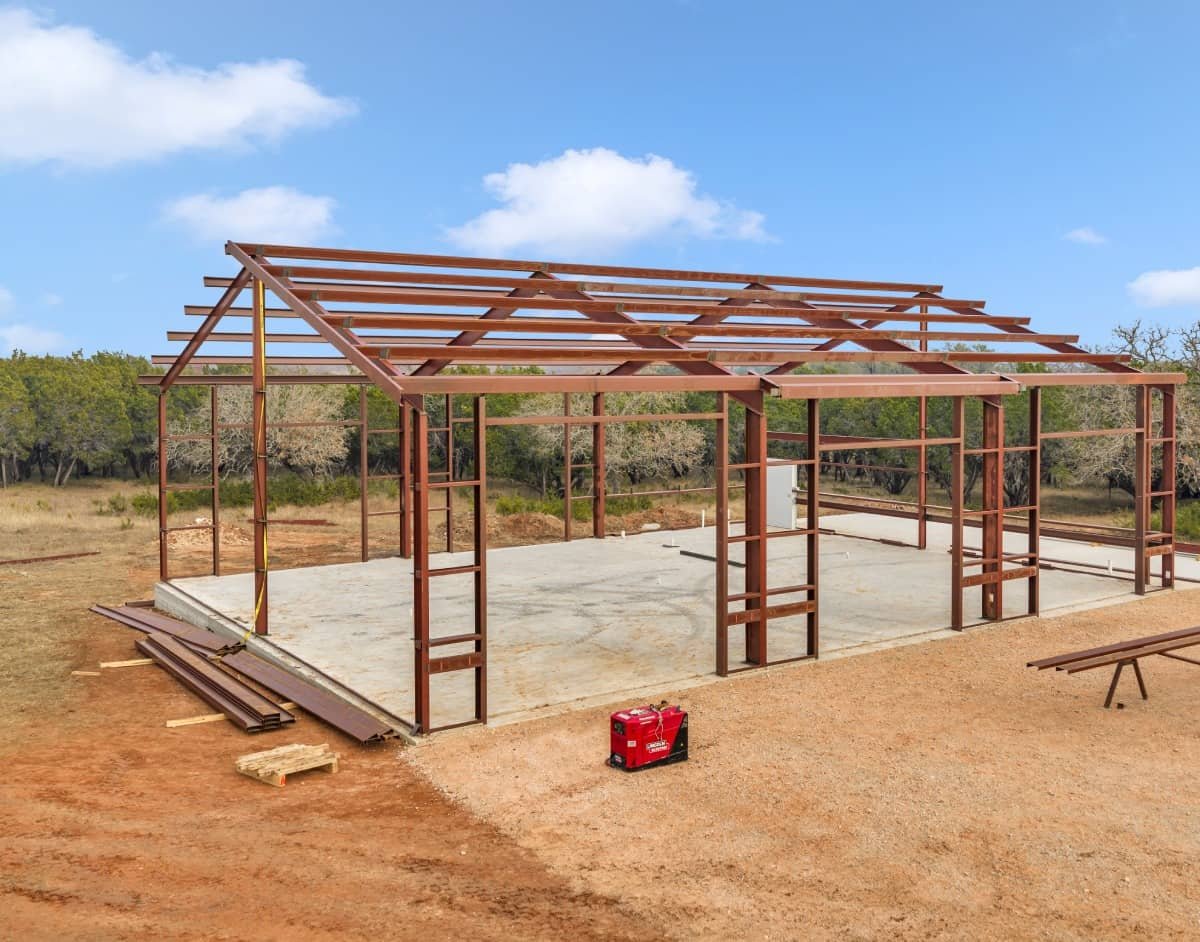
Metal Buildings in Houston, Texas
In Houston the pad comes first, and the pad here is flat, wet clay that wants to move. We erect pre-engineered warehouses, truck shops, yard buildings and storage for the port-side and ring-road markets, and the first line item we study is the pad: its elevation, its drainage and what lies beneath it. Get that right and the frame, panels and doors are the easy part.
The market is huge. In 2025 the public terminals at Port Houston moved 54,491,066 short tons of cargo, and the port calls the Houston Ship Channel complex, which has more than 200 private and eight public terminals, the nation's largest port by waterborne tonnage. That much freight needs places to stage, store, repair and re-load, and much of it lands in steel buildings on the ring roads.
Our job is to make the building simple for you. We give a package price per square foot, a separate site and foundation number, and a written steel lead time. Houston owners are used to hearing a low number up front and a higher one later, and we try not to work that way. Then we show you what could move any of them: soil, flood elevation, utility service or a permit comment.
Port freight, ring roads and a vacancy rate
Port Houston said in its January 30, 2026 release that it has $2.1 billion in planned landside capital investments over the next five years to improve capacity and support cargo fluidity across its public terminals. That spending is aimed at the terminals themselves, but the whole chain of drayage yards, container repair shops and cross-docks that sit on the ring roads benefits. George Bush Intercontinental Airport, with 10,000 acres and five runways, adds air cargo and its own set of support businesses.
Airport-area users, such as freight forwarders, ground handlers and parts distributors, often want 10,000 to 40,000 square feet of steel-framed space with at least a few dock-high doors. Nothing about their building is exotic, but the lot needs good truck access. The road structure is concentric. Interstate 610 is the inner loop, Beltway 8 has a radius of approximately 10 miles from Downtown, and State Highway 99, the Grand Parkway, has a radius of 25 miles. Choosing the ring for a building is mostly a choice about customers, labor and truck time. A 2026 report put Houston-area industrial vacancy at 6.8 percent in the second quarter, which tells a tenant or investor that space is not hard to find but good space is not free.
Flat clay, drainage and sinking ground
Houston is described as a flat, marshy area with an extensive drainage system, low-permeability clay-silt prairie soils and recurring flooding. For a building, that means the finished floor must sit above the street and the base flood elevation, the site must drain to an approved outlet and the detention pond often takes a bigger share of the lot than owners expect. We ask for the drainage plan and the floodplain map before we price. The lot's relationship to the nearest bayou or ditch also matters, since the district that owns the channel may set its own rules for outfalls. Add the time for those approvals to your schedule, and do not buy steel until you know the answer.
The Texas Legislature created the Harris-Galveston Subsidence District in 1975 to regulate groundwater withdrawal in Harris and Galveston counties, and the district publishes maps of subsidence rates. Subsidence means the ground has sunk in some places, and it affects elevations and utilities. A soils engineer reads those conditions and sets the foundation, whether that is a stiffened slab, a thick pad on select fill or piers. Our anchor bolts and foundations page covers the principle.
Plan review in Houston and its neighbors
Texas municipalities use the International Building Code for commercial buildings, with local amendments adopted by ordinance. Within Harris County, the city, unincorporated areas and other cities have separate review processes. We confirm which jurisdiction applies to your lot, and that decision shapes the timeline.
Coastal wind is a design input for the stamped drawings, along with roof and wall component loads. The state's energy code is the IECC, which we reflect in insulation and glazing. The state's flood planning work, which grew out of a 2019 law that created the first state flood plan, is a reminder that regulators are paying close attention to where water goes.
What we build near the port and ring roads
The most common requests are truck and trailer shops, cross-docks, container repair buildings and covered storage for equipment. Warehouse buyers want 24 to 32 feet of clear height and plenty of dock doors. See warehouse for the usual layout. Logistics firms look at logistics and fulfillment space.
A truck shop usually wants 16 to 20 feet of eave, a drive-through layout with doors on both ends, a heavy slab, trench drains, floor sumps and good ventilation. A cross-dock wants a narrow, long footprint and plenty of doors on both sides. A yard building for chassis, tires or containers wants a high eave and few interior columns. A metal building can serve as a shell for either. The frame spans wide, the panels go up fast and the floor is a poured slab. What differs is how you finish the interior and how you handle trucks.
What moves a Houston building budget
Some owners ask about the cheapest way to start. The answer is a simple clear span with a modest eave, a basic insulation package and a standard door count, and a plan to add what the business proves it needs. Land and site work are the swing items. A lot inside a ring road costs far more than one outside it, and flood and detention requirements vary by watershed. The building package scales with size and height. Insulation, mezzanines and doors are the next layer.
We give you unit prices, so you can test options. A taller eave or a thicker slab changes the number, and so does a detention pond. Add contingency for the surprises that come with any urban site.
Beyond the loop
The same questions about pads and drainage apply in every part of the metro. We serve the suburbs on every side. The western edge is covered on our Katy page and our Sugar Land page, where the Grand Parkway shapes the market. Owners in the rest of the metro should call.
Our warehousing and distribution page shows how we support operators across the region.
Get a Houston building price that includes the pad
Tell us the lot, size and use. We will return a package price, a foundation and site estimate and a steel lead time, plus a note on flood and drainage.
Common Questions
How much does Houston clay add to foundation cost?
It depends on the geotechnical report. A stiffened slab or select fill pad is common. Piers cost more. We price the foundation as its own line.
Does subsidence affect a new metal building?
It affects site elevations and utilities more than the frame. The engineer reads the local conditions and designs accordingly. Ask us for the district's maps as part of due diligence.
Is a 6.8 percent vacancy rate good for a buyer?
It means space is available, but quality varies. If you need a specific clear height or dock count, building can beat leasing. We compare real numbers.
How tall should a port-area warehouse be?
For racking, 28 to 32 feet clear is common, while a yard building or shop may need only 18 to 22. The height changes the frame, the slab and the cost.
Should I build inside Beltway 8 or farther out?
It depends on your customers and drivers. Inside the beltway you pay more for land and get shorter trips to the port and downtown. Outside, land is cheaper and sites are larger, but trucks log more miles. Many owners compare two or three lots on total annual cost, not just purchase price, and we help with the building side of that comparison.
Which jurisdiction reviews my plans?
It depends on whether the lot is in the city, another city or unincorporated Harris County. We check before drawing.