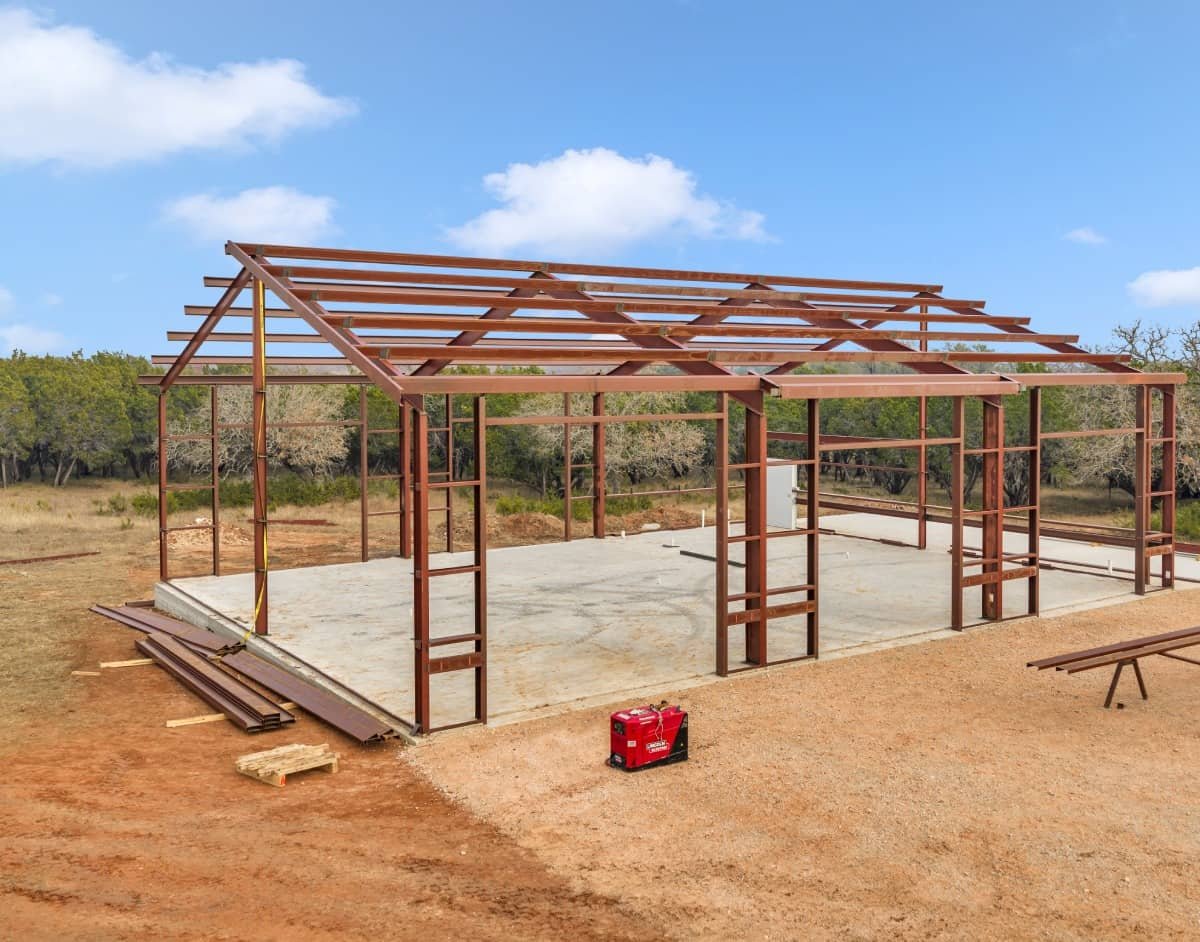
Government and Municipal Building Construction in Texas
Public money comes with a procurement clock, and a metal building contractor who ignores it will lose the job before the steel is ordered. A city public works yard, a county road barn, a fire station, a water plant building or a municipal airport hangar all start the same way: a funding source, a scope, a solicitation and a deadline that cannot slip because a council meeting is fixed on the calendar. We build for that process, and we say so at the start of every conversation with a public owner.
The buildings themselves are well suited to pre-engineered construction. Fleet maintenance shops, salt and material storage, equipment bays, recreation centers, animal shelters, EMS stations, water and wastewater process buildings and airport hangars are largely wide, tall, open and durable, with few finishes, and that is the profile of a rigid frame. A public owner gets a firm price, a quick schedule and a structure that is easy to maintain for decades.
The material below describes how we approach municipal and government work in Texas, and what an owner should expect.
Procurement first, then drawings
The Texas Comptroller's Statewide Procurement Division connects vendors with state purchasers and helps state and local governments buy through statewide contracts. Its vendor resources include the Electronic State Business Daily, the Centralized Master Bidders List and the TxSmartBuy ordering system. We register where it matters, monitor solicitations and read the instructions before we price.
Public owners have rules that private owners do not: formal bid forms, bonding requirements, prevailing wage in some cases, and rules on how contractors are selected. We prepare a complete bid package with a firm price, a schedule and a list of exclusions that an evaluator can compare easily. When a city or district selects a delivery method that allows design-build, our design-build service lets us carry the project from concept to keys. Where a project is bid on completed drawings, we price to the documents and ask our questions in the pre-bid period, not after award.
What Texas public owners are building
Public utilities and public works are a large buyer class. Garland Power and Light serves over 69,000 customers and is described as the fourth-largest municipal utility in Texas, and a utility that size maintains warehouses, service centers and substations on a continuous basis. Denton has a public airport about 3 miles west of the center of town, and municipal airports generate hangar and terminal-support demand.
Water is the other big one. Texas voters approved Proposition 4 on November 4, 2025, which directs up to $1 billion a year from existing sales tax revenue, starting in 2027, to water supply projects and existing programs including flood mitigation, about $20 billion over two decades, administered by the Texas Water Development Board. The state's first flood plan, built from 15 regional plans, points the same direction. Pumping stations, treatment buildings, chemical storage and operations shops are the buildings that flow from those programs, and they suit a frame.
Buildings for crews, fleets and process equipment
The most common job is the fleet and public works building. It has drive-through bays for trucks, a mechanic area with lifts and a hoist, parts storage, a wash bay with an oil-water separator and a small office with a break room. We frame it with high eaves for lifts, large overhead doors and a slab designed for heavy axle loads.
The next group is storage and process buildings: salt domes and sand and gravel shelters, chemical rooms at water plants, pump station buildings with removable roof panels for equipment replacement, and cold storage for municipal supplies. Then come recreation centers and community buildings, which use a clear span and finish the interior like any civic building, and aircraft hangars; see our aircraft hangar page. The municipal and public works industry page shows more examples.
Public buildings and accessibility
Public buildings must serve the whole public, so accessibility is a primary concern. The Texas Department of Licensing and Regulation administers the Elimination of Architectural Barriers program, and the Texas Accessibility Standards apply to projects registered, permitted or constructed under that program. Projects with a total estimated cost of $50,000 or more must submit construction documents for registration, and plan review comes before inspection. Projects under $50,000 are not submitted but must comply.
On the building code side, state law makes the International Building Code the municipal commercial baseline and lets each city amend it by ordinance after a public hearing. For state-funded buildings, the State Energy Conservation Office lists ASHRAE 90.1 or the IECC as the energy standard. We confirm the exact edition in writing with the building official or the owner's architect before we finalize the frame design.
From award to ribbon cutting
A public job moves in steps that a private job can skip: council or board award, a contract signing, a notice to proceed, submittals the owner's engineer must approve, and a formal substantial completion inspection. Each takes days or weeks. We build those steps into the calendar, so the first date the owner sees is realistic and not a best case.
Steel fabrication begins once shop drawings are approved, and the foundation work runs at the same time. Weather days, utility relocations and change orders are tracked in writing, because a public file is audited. We close out with record drawings, warranties and operation manuals, since municipal facilities managers will use them for decades. A fleet building of moderate size can move from notice to proceed to occupancy in a season when the site is ready.
Controlling cost for people who answer to taxpayers
Public budgets are public records, so we price in a way that a council member can read. A line for the building shell, a line for site work, a line for the slab, a line for mechanical and electrical, and an alternate list that shows what each upgrade costs. We include add-alternates for a standing seam roof, insulated panels and a higher clearance so that the owner can choose at award.
Life-cycle cost matters as much as first cost. A standing seam roof costs more up front and lasts longer, so for a public works building with a long hold we show both options side by side. For related approaches see our school and hospital campus pages, which cover other public and institutional owners, and our standing seam roofing page.
Bidding or planning a public building?
Send the solicitation or the scope and the bid date. We will return a clear bid with alternates, bonds and a schedule.
Common Questions
How do we find out about state solicitations?
The Comptroller's Electronic State Business Daily lists state contract opportunities, and the Centralized Master Bidders List helps vendors get notices. Local governments post their own bids and often use cooperative purchasing.
Do public buildings need bonds?
Most public bids require bid, performance and payment bonds above set thresholds. We provide them and price the cost into the bid.
Which accessibility rules apply to a city building?
The Texas Accessibility Standards under TDLR. Projects of $50,000 or more must register the construction documents and pass plan review before inspection.
Can a salt shed or pump building be a metal building?
Yes. These are among the best uses. We detail corrosion-resistant finishes and engineered details for chemical or salt environments.
Does a county build outside a city's code?
Often a county has no building code like a city, so the owner's architect sets a standard. We design to the standard the owner selects, and we still follow accessibility, fire and utility rules.