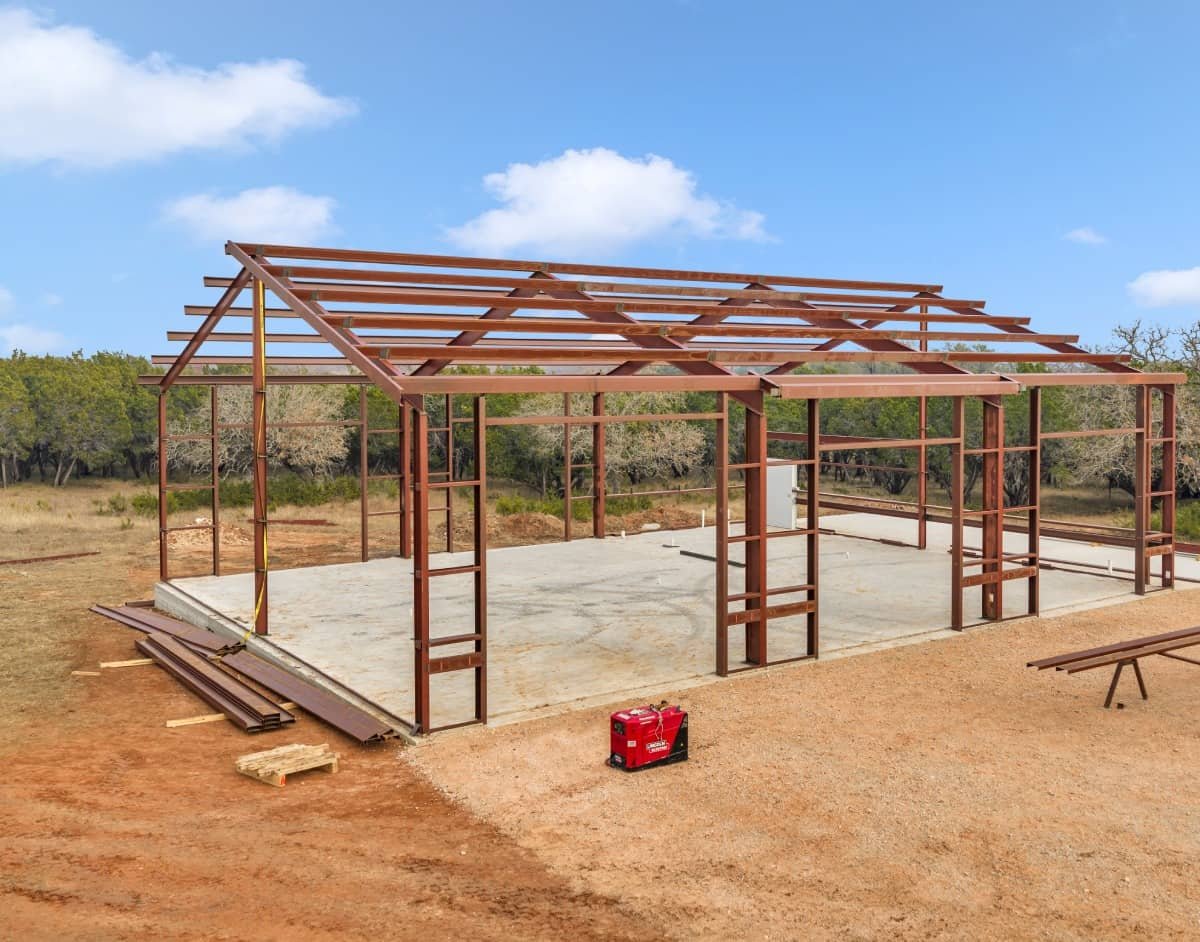
Truck and Equipment Shop Buildings in Denton, Texas
Heavy-truck service is the work that defines a good Denton shop building, and the numbers start with the door. A tractor needs a wide, tall opening with room to turn, a floor that can take concentrated wheel loads, and a roof high enough for a raised cab or a lift. We build pre-engineered steel shops around those dimensions, with drains, ventilation and lighting that suit a service bay instead of a showroom.
The city fits that work. A heavy-truck maker is headquartered in Denton with about 2,000 employees, according to a public reference list, and the area is crossed by I-35E and I-35W, which rejoin near the university campus in southwest Denton. Loop 288 partly encircles the city, U.S. 77 and U.S. 377 pass through the town square, and U.S. 380 connects Denton east to Frisco and McKinney and west to Decatur. Fleet and equipment owners choose Denton lots for that spread of routes.
We discuss the building the way a shop foreman would: how many bays, how deep, how tall, where the parts room goes and how the trucks turn.
Bays for trucks and trailers
A single drive-through bay for a tractor-trailer is about 70 feet long, and a drive-through lets a truck enter and exit without backing. We design the frame so the doors on both ends are as wide and tall as the trucks need, often 14 feet by 16 feet, and we size the headers and jambs for that opening. Interior columns are avoided with a clear-span design wide enough for two bays side by side.
Inside, we frame a parts room, a break room and an office along one side wall. A mezzanine over the parts area keeps inventory off the shop floor. Our automotive and fleet page lists the layouts we price most often, from a single-bay quick service to a multi-bay repair shop with a wash.
Slabs, drains and shop details
The slab is where heavy-truck shops are won or lost. We recommend thick, reinforced concrete with proper joints, and a heavier section at the door aprons and lift locations. A slope toward trench drains keeps wash water away from the work area, and an oil separator is often required before water leaves the site. Check with the city before designing it; we handle the coordination.
Overhead doors, high-bay lighting, exhaust ventilation, compressed-air lines and floor drains are the details that matter day to day. Where a shop needs a bridge crane or a jib, the frame is designed for it from the start; see crane-ready industrial buildings for how that changes the column and runway design.
What we manage on the steel
The erection crews we schedule and inspect set the anchor bolts, raise the primary frame, install girts and purlins, and hang the panels. They also install doors, flashing and trim. Supervising this work closely helps schedule and quality, because the people who read the drawings are on site while it is built.
We coordinate concrete, electrical, plumbing and mechanical trades under our schedule, and we hold them to the same standards. That cuts finger-pointing and gets you a single phone number for the whole job. For owners who prefer to run their own trades, we are comfortable working inside that arrangement.
Universities, fleets and a growing town
Two large universities, one over 42,000 students and one with more than 13,000, shape the town's economy with campus buildings and an active employer base alongside a beauty-products company and a municipal electric utility that has operated for more than a century. That variety of employers supports a steady need for storage, maintenance and warehouse space. Denton Enterprise Airport lies about three miles west of the central business district, which adds aviation tenants.
A commuter rail line, the DCTA A-train, serves five stations in Denton. For a small business, the more important question is the road network and the labor pool, and the I-35 and U.S. 380 corridors connect to both.
Soil, drainage and what to ask
North Texas clay moves with moisture, so the geotechnical report decides whether the shop sits on a slab, piers or a mix. We ask for the report early and design around it. We also check drainage, since a large roof and a paved apron shed water quickly and the lot must take it away without flooding the neighbor.
Neighbors and next steps
Denton sits at the northern end of the metro, and owners often compare it with Lewisville to the south and with Frisco and McKinney to the east, all reached by U.S. 380 or I-35E. Each has different lot prices and review habits, so we are glad to price the same building in more than one place.
If your Denton operation is closer to farm and ranch supply than to truck service, our agriculture and agribusiness page describes feed, equipment and hay storage buildings, and our structural steel erection page covers the heavier framing that some of those buildings use. For owners with a small fleet, a commercial metal building with two or three bays is often the right size to start, and it can grow later.
What a truck shop costs
Door size and count, the thickness of the slab and the drain system are the three line items that separate a truck shop from a warehouse. A heavy slab costs more per square foot, and the aprons outside the doors carry the same loads. Lifts, if you add them, need pits or reinforced pads. We list those items so you can compare options and decide what to include in the first phase.
Insulation is a second choice. A shop that is heated in winter and cooled in summer needs wall and roof insulation, while a shop that opens its doors all day may do better with ventilation and fans. We price both so you can see the difference, and we explain the effect on comfort and energy.
Send us the Denton job
Tell us what will park, work or be stored inside, the largest vehicle or machine involved and the lot you have. We will return a building concept, a firm price per square foot and a schedule for each stage.
Common Questions
How wide should the doors be for tractor-trailers?
Most heavy-truck shops use doors about 14 feet wide and 14 to 16 feet tall, but your equipment decides. Give us the tallest and widest unit, including mirrors and roof gear, and we size from there.
Do I need an oil separator?
Often yes, if the shop has floor drains that could carry oil or solvents. Requirements come from the city and the utility, and we confirm them during design.
Can I put a crane in a pre-engineered building?
Yes, if it is designed for it. The frame gets heavier columns and a runway beam, and the foundation is sized for the loads. Adding a crane later without planning is expensive.
How long will the building take?
Permit, foundation, steel fabrication, erection and finish each have a duration. We give you the schedule in writing with the steps we control and the steps we do not.