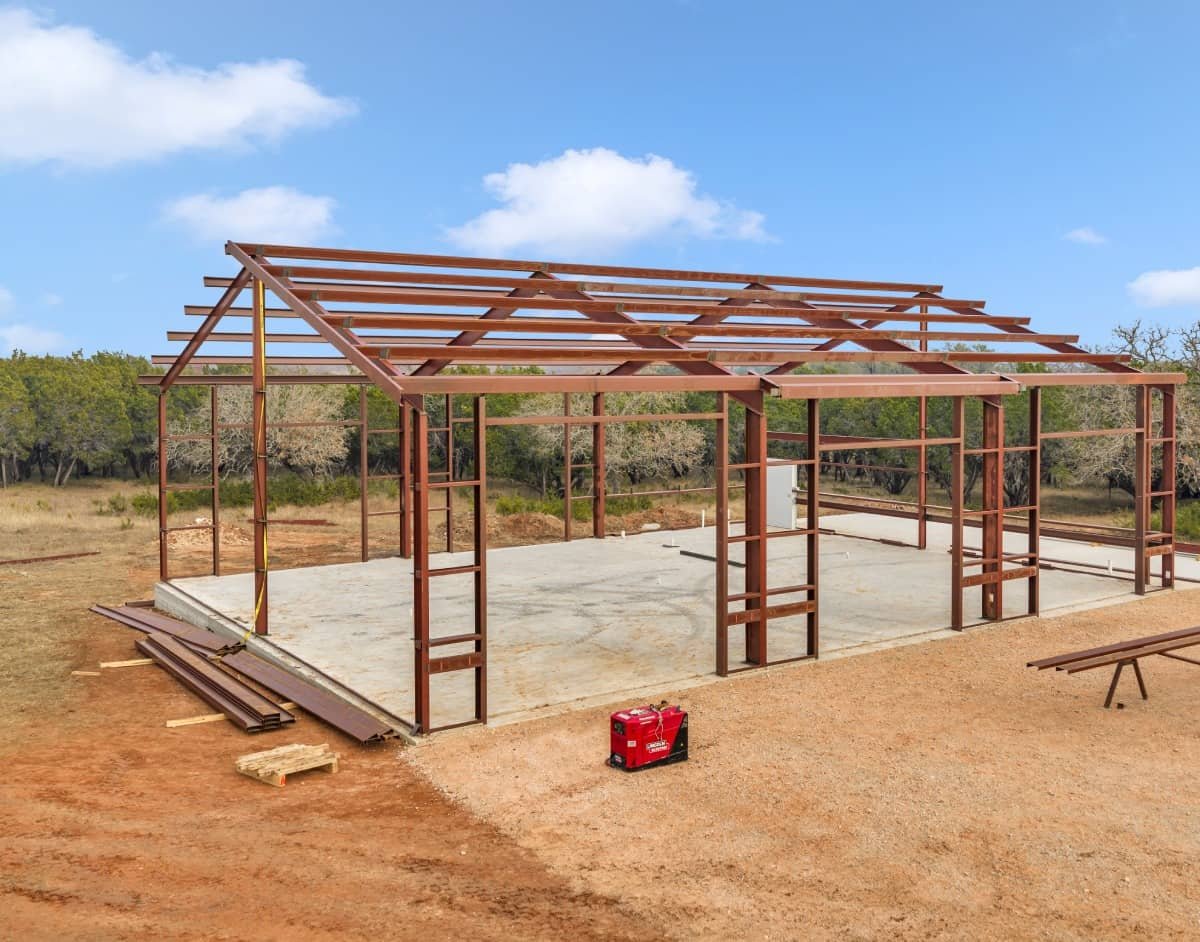
Boat, RV and Storage Buildings in Lewisville, Texas
Boat and RV storage is a natural use for a clear-span steel building in Lewisville, and the lake explains why. Owners who keep boats, trailers and motorhomes want a covered, dry, secure place to park them, with tall doors and room to turn. A pre-engineered building gives that at a modest price per square foot, and its wide spans leave the floor open for stacking or drive-through lanes.
Lewisville Lake was enlarged by the Garza-Little Elm Dam, finished in 1954, and a public park of 662 acres sits on land leased from the Army Corps of Engineers. A public reference page says water makes up about 14 percent of the city's total area, including the lake and the Elm Fork of the Trinity River. That much water means a lot of recreational owners and a lot of floodplain, so a careful site check comes before every design.
I-35E runs north to south through the city, the Sam Rayburn Tollway meets it at the southeastern edge, and FM 1171 (Main Street) crosses the middle. Most parcels sit within minutes of one of them.
Floodplain, drainage and the lake
Before we draw anything, we ask the city for the floodplain status of the lot and for any drainage easements. Parcels near the Elm Fork or the lake edge can sit in a mapped flood zone, and building there requires an elevation certificate and a raised finished floor. We design for that, with a pad built above the design flood elevation and an outlet for stormwater.
Soil near the water can be soft or variable, so a geotechnical report is not optional. The engineer may call for piers, a thickened slab or a pad of compacted select fill. We follow it. Gutters, downspouts and swales carry water away from the slab edge, and we do not tie rainwater into a sanitary line.
Boat, RV and self-storage
An RV and boat storage building has bays, usually 12 to 14 feet wide and 14 to 16 feet tall at the door, with a lane in front wide enough to maneuver a long trailer. The frame can be a simple clear span with partitions that make individual units, or an open bay for rented spaces. Many owners start with one building and add more as demand grows.
Our self-storage metal buildings page explains the door options, the security features and the unit mix. For owners who want to run the business more than build it, we cover the planning in our page for self-storage operators, and we build the facility to the plan your operator or lender wants.
What we build
The scope is straightforward: foundation coordination, anchor bolts, rigid frame, wall and roof panels, doors, gutters and trim. We add lighting, a security gate and fencing when you want them. We keep the walls simple and the panels durable, because storage customers care more about a dry unit and a working door than about decoration.
Roof panels in a lake city take wind, rain and sun, and the finish matters. A good paint system on the panels and a sealed fastener pattern last longer and need less touch-up. We explain the options and the cost difference.
Retail, rail and employers
Lewisville has more than recreation to support its building demand. A large bank, the school district and a mortgage servicer are named among its major employers, and the city's mall at I-35E and Round Grove Road opened in 1989. The DCTA A-train serves the city, with a Hebron station opened alongside the Old Town and Highland Village stations. The result is a mix of retail, service and residential neighbors, and some lots are close to housing. We take care with lighting, fences and landscaping so the building fits in.
What a storage or light commercial building costs
The cost of a lake-area building depends more on the site than on the steel. Fill to raise a pad above the flood elevation, drainage structures, a driveway wide enough for long trailers, and fencing and gates can match the cost of the frame. We price each so you can decide whether to build one larger building, or two smaller ones that work with the lot.
The steel package itself is mostly a function of the span, the length, the eave height and the wind and snow design. Doors are the other major item: a large door with a motor costs several times a small manual door. For a storage business, door count and size drive revenue, so we help you balance them. Insulation is optional for storage but valuable for climate-sensitive items. See commercial metal buildings for the base package.
Permits near the water
A lot near the lake or the Elm Fork may need review for floodplain development, drainage and, in some cases, a federal permit if work is close to a regulated area. We ask the city which approvals apply and build the time into the schedule. The city building department reviews the permit set, so the engineer works from whatever requirements the city confirms.
Energy code rules differ for conditioned and unconditioned space. A storage building with no heat or cooling has a lighter path than an office or retail space, so we separate those areas in the drawings. We also verify fire access and hydrant locations for larger buildings.
Nearby markets
Owners often compare Lewisville with Denton to the north and with Plano to the east, and we are glad to price the same storage building in each. Contractors and equipment dealers in town can also read about shop layouts on our recreation and sports facilities page, which covers marine and powersports dealers, and on our flex and light-industrial page for combined office and storage.
Seasonal timing
Boat and RV storage fills up in spring and early summer, so owners want the building open before the season. Working backward from that date, we get the permit moving first, then schedule the foundation for a dry window. Steel is ordered when drawings are approved. If delays occur, we tell you which step is behind and what we can do to recover.
Price Lewisville storage or shop space
Send the parcel and what you want to store or make. We will check floodplain and drainage first, then return a building concept, a price per square foot and a schedule.
Common Questions
Can I build in a floodplain?
Sometimes, with an elevation certificate, a raised pad and a stormwater plan the city accepts. We ask the city for the flood status of your lot before design and tell you early if it will be a problem.
What door size works for RVs?
Many RV bays use doors 14 feet tall and 12 to 14 feet wide. Tell us your tallest unit, and we will size the door to clear it.
Can I expand a storage building later?
Yes. Plan an end wall for extension and leave room on the lot. It is cheaper than building a separate structure.
Do I need fire protection?
It depends on the building size, use and the city's rules. We ask the fire marshal for requirements during design.