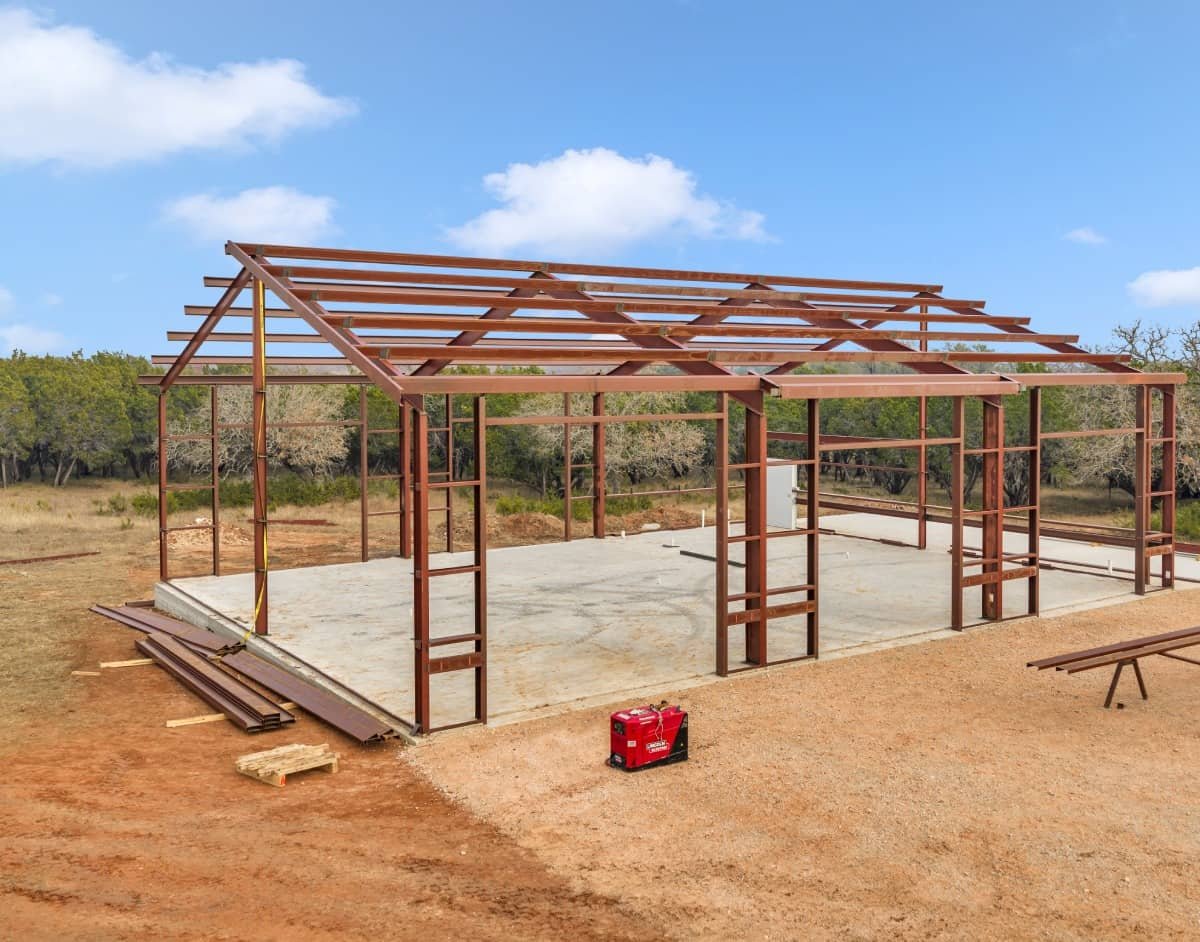
Shop and Small Industrial Metal Buildings in Hutto, Texas
Contractors, fabricators and fleet owners who need a working shop in Hutto want to know three things: what it costs per square foot, when the steel arrives, and what the town will ask for before it issues a permit. We answer all three up front, in writing. Our standard shop is a clear-span rigid frame with a heavy slab, a few overhead doors, and a small insulated office on one end.
The crossing of Highway 79 and FM 1660 puts Hutto in the lower middle of Williamson County, a short drive down Highway 79 from Round Rock, which is seven miles to the west. Downtown Austin lies roughly 22 miles to the southwest. That puts a yard here within a short drive of the Round Rock job sites and the I-35 corridor, with lower land cost than the west side of the county.
The town has grown quickly. State handbook figures show 14,698 residents in 2010 and 27,577 in the 2020 census, which is close to double. More homes bring more trades, deliveries and service vehicles, and those operators need covered space. We plan the building, order the steel, and schedule, coordinate and inspect the trade partners who pour, erect and finish it.
Permits and plan review for a Hutto shop
A commercial shop goes through the local building department and, depending on the lot, a site plan review. Expect questions about setbacks, parking, fire access, drainage and screening of outdoor storage. Our drawings are stamped by an engineer, and we answer reviewer comments quickly so a permit does not sit in a queue. A site plan can take longer than the building permit itself, so we ask for that timeline when we start.
Wind load and the slab are the structural basics. The engineer sizes the footings and anchor bolts, and we check the bolt layout against the drawings before the pour. If your building holds a lift, a press or a bridge crane, tell us now. Heavy equipment changes slab thickness and sometimes the column spacing, and that is far cheaper to settle on paper than after the frame is up.
Services that turn a shell into a working shop
A shell becomes a shop through finish choices. Insulated wall panels keep a welding bay or paint booth comfortable. Our insulated metal panels page compares them with a standard liner. A mezzanine over an office or parts room adds floor area without widening the footprint, and our mezzanines and platforms page explains the options.
Owners also ask about growing later. Leaving an end wall unclad and a slab edge ready for extension keeps the cost of an addition low. Our commercial metal buildings page covers storefront-style fronts for owners who want customers to walk in off the street.
Who builds small industrial space here
Hutto buyers range from plumbers and electricians with a yard and a parts room to small manufacturers and equipment dealers. Our automotive and fleet industry page explains how we size bays, doors and floor drains for vehicle work, and how a lift or wash bay changes the slab.
Recreation and community groups also buy steel here. A higher education center in the eastern part of the county, run jointly by Texas A&M University-Central Texas, Texas State Technical College and Temple College, serves Hutto, which tells us the area expects training and trades work to grow. For leagues, clubs and fellowship groups, our recreation and sports facilities page shows gym, practice and event building options.
Matching the calendar to a firm delivery window
Permit approval, steel production and site work are three clocks that start together. Steel lead time is the longest, and we state it in writing and update it if the mill or fabricator changes. While steel is being made, trade partners grade the pad and set forms, so the slab is ready when the frame arrives.
Erection of a mid-size shop moves fast once the steel is on site, usually measured in days and not weeks. Panels, doors, and any insulation follow, then final inspection. If you must be in by a certain date because of a lease or a contract, tell us at the start. We can phase the work, such as occupying the shell before the office is finished.
Rain is the other schedule risk. A wet week delays a pour, and a pour delayed by a week pushes erection by the same amount. We keep a slot open with the trade partners and watch the forecast, so a short delay does not turn into a lost month. We also tell you early if the steel is going to arrive before the slab can take it, since storing a frame on the ground costs money.
Lots, drainage and access east of Round Rock
Many Hutto lots are flat to gently rolling, and clay soil moves with moisture. We ask for a soil report on any building that carries heavy loads, and we grade the pad so water leaves the site without ponding at doors. Truck turning radius matters too. A shop door that cannot be reached by a delivery truck is a shop with a problem.
For a nearby comparison, see our Round Rock page, and for the farm and industrial side of the county, look at Taylor. Owners weighing a county seat location can read our Georgetown page. In each place we check utilities early, since a water or sewer tap can affect schedule more than the steel does.
Yard space is the part owners forget. A contractor with six trucks and a trailer needs turning room, parking, a place for pallets and a way to get a flatbed through the gate. We draw the building on the lot with those paths shown, because moving a door after the slab is poured costs far more than moving it on paper.
Price your Hutto shop
Send the lot size, your equipment list and the door sizes you need. We will return a building price, a separate site estimate and a steel lead time, with any permit steps that could affect the date.
Common Questions
What size shop do small trades usually build?
Many start with 40 by 60 or 50 by 100 feet, enough for vehicles and a parts room. We size by what you park, store and work on, plus room for growth. Tell us your largest truck or machine and we pick eave height and door size to match.
Can I add an office inside the building?
Yes. A framed, insulated office with a restroom fits at one end of most shops. It needs plumbing, power and an HVAC plan, and it affects the permit, so we include it in the drawings from the start.
Does Hutto allow outdoor storage?
Rules vary by zone and use. The building department can tell you what screening and surfacing are required. We design the building and pad so you have options either way.
How long does it take to get a shop built?
The timeline is permit, steel production, site work and erection. Steel lead time is the longest piece and changes with the market, so we quote it in writing. Erection itself is quick.
Can a church or club use the same steel system?
Yes. A gym, fellowship hall or activity building uses the same frame types with different finishes, such as insulation, ceiling and restrooms. We price those items separately.