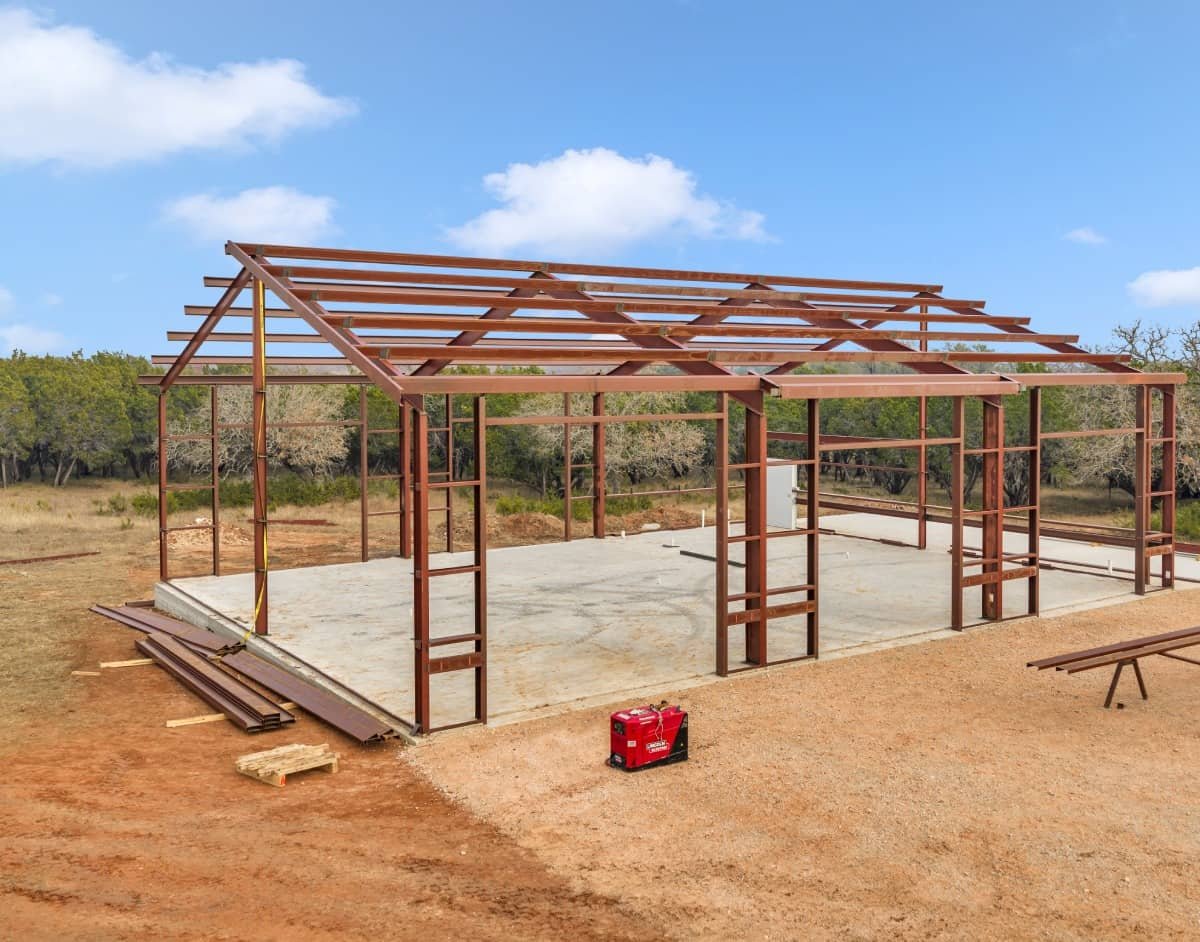
Metal Buildings in Round Rock, Texas
Light industrial owners in Round Rock tend to want the same thing: a clean, insulated, high-ceiling space with a couple of dock doors, close to a toll road, and ready before the lease on their current space runs out. A pre-engineered steel building is the fastest way to get that, and it is what we build here. We erect the frame, enclose it with wall and roof panels, and hand you a shell sized for how you work.
The city is well placed for it. Round Rock is served by I-35, US 79, State Highway 45 including the SH 45 toll road, and the State Highway 130 toll road. A service business can reach the north Austin suburbs, Georgetown and Pflugerville without crossing the center of Austin, and a distributor can pick a lot close to an interchange and run trucks in both directions. Frontage and truck access are the first things we look at when we walk a lot.
We keep the process plain. You tell us the square footage, clear height and door count. We give you a building package price per square foot, a separate number for the slab and site, and a written steel lead time. Anything that changes the price is named before it changes. If a number moves, you hear about it from us first, and you see the reason in writing. That habit is how we keep a first estimate close to a final invoice.
A tenant base that needs flexible space
Round Rock is the international headquarters of a large computer maker, and the city lists more than 20 major employers across industries such as lab supplies, industrial products, electrical equipment, furniture retail, photomask production and precision manufacturing. We do not build for those companies. What matters to us is what the cluster means for the buildings around them: small suppliers, calibration and repair shops, packaging operations and last-mile warehouses all look for 5,000 to 40,000 square feet near the tollways.
That demand matches a flexible shell. Our page on flex and light industrial buildings describes how we frame them: a clear span interior, a reinforced slab, a rear overhead door and a front section that finishes as office or showroom space. The shell goes up quickly, and the tenant improvement can follow on its own schedule.
Workforce is part of the picture too. A state university campus in Round Rock provides training programs for work at local companies, which is one reason small technical suppliers choose the area. If your company needs technicians who can read a drawing and run test equipment, a building near that talent pool is easier to staff. Larger vehicle and equipment users farther south of town are covered on the Austin page, and the plant-supplier story to the northeast shows up on our Taylor page.
What we put up around Round Rock
The most common requests are service shops, small warehouses and contractor yards. A metal warehouse with 24 to 28 feet of clear height handles pallet racking, and a shop with a 14 foot eave handles a truck or a lift. Owners who run a team of installers, technicians or inspectors often want a mixed building, with shop space in back and an insulated, finished office at the front.
Sports and recreation facilities are a smaller but real category. The city is home to a Triple-A baseball team, and a youth training facility, a batting cage building or an indoor court uses the same clear span structure as a warehouse. We cover that in recreation and sports facilities, and the same clear span thinking applies to a clear span building of any kind. A volleyball court needs roughly 23 feet clear, a batting tunnel needs length, and neither needs a dock door.
Turning a lease decision into a build decision
Many Round Rock buyers compare buying land and building against leasing space. The honest answer depends on the monthly numbers, but a shell with your exact clear height, door placement and electrical service often earns its premium over a generic lease. We help you run the comparison with real square foot numbers, not a sales pitch.
Brushy Creek and its tributaries run through the area, and the city is named for a rock that served as a low-water crossing there. Creeks mean floodplain checks, drainage easements and detention requirements on some lots. We walk the lot for those items before you commit, check the setback from the creek bank and the utility easements, and we will tell you if a cheaper-looking parcel will cost more once the site work is counted.
Where the money goes
The building package, meaning the frame, roof and wall panels, trim and fasteners, is the part of the cost that scales most predictably with size. The foundation, utilities, paving and permit costs are specific to the lot. Insulation, doors and mezzanines are the next tier.
Texas cities use the International Building Code for commercial buildings, with the energy code applied statewide, so a heated and cooled building needs real insulation values. We design the envelope to meet them rather than guessing, since the energy code the state adopts and enforces applies to commercial buildings statewide, and we show the difference between a blanket system and insulated metal panels in plain dollars.
From deposit to open doors
Site and permit work run alongside steel fabrication. For a typical Round Rock shop, the longest stretch is waiting for the building package, so we order as soon as the engineering is stamped. Erection is quick once the slab is cured. We give you a written lead time and a notice if it moves.
If you need a path to expansion, we frame the end wall for it. An addition built later costs far less than starting over. For a different corridor market, see our Georgetown page, where the permitting picture is different.
Size your Round Rock building with us
Send the square footage, clear height and door count. We will return a building package price, a slab and site estimate, and the current steel lead time.
Common Questions
What clear height should a Round Rock flex building have?
For pallet racking, 24 to 28 feet at the eave is common. For service shops and light assembly, 16 to 20 feet is enough. Taller eaves cost more because the columns and wall panels get larger and the wind loads grow. Pick the height from the equipment you will actually use, not a guess about the future.
Can I get toll road frontage and still afford the lot?
Frontage costs more per acre, but a smaller lot can work if the building is tall and narrow. We help you test the layout against dock, truck turning and parking before you buy. Sometimes a lot one block back saves enough to pay for a larger building.
Do I need a drainage study for a lot near Brushy Creek?
If the lot touches a mapped floodplain or a drainage easement, expect the city to ask for one. Detention ponds take land and can change the building footprint. Ask us to review the survey before you close on land, not after.
How do I add office space inside a metal shell?
We frame an insulated office at the front or build a mezzanine over the shop floor. Mezzanines make sense when the ceiling is tall and floor area is tight. The structure for a mezzanine is designed with the building so the columns line up.
Can you build a training or recreation space?
Yes. The clear span structure suits indoor courts, batting areas and gyms. You need to specify height, flooring and any spectator areas early, and we coordinate with your designer on lighting, ventilation and egress.