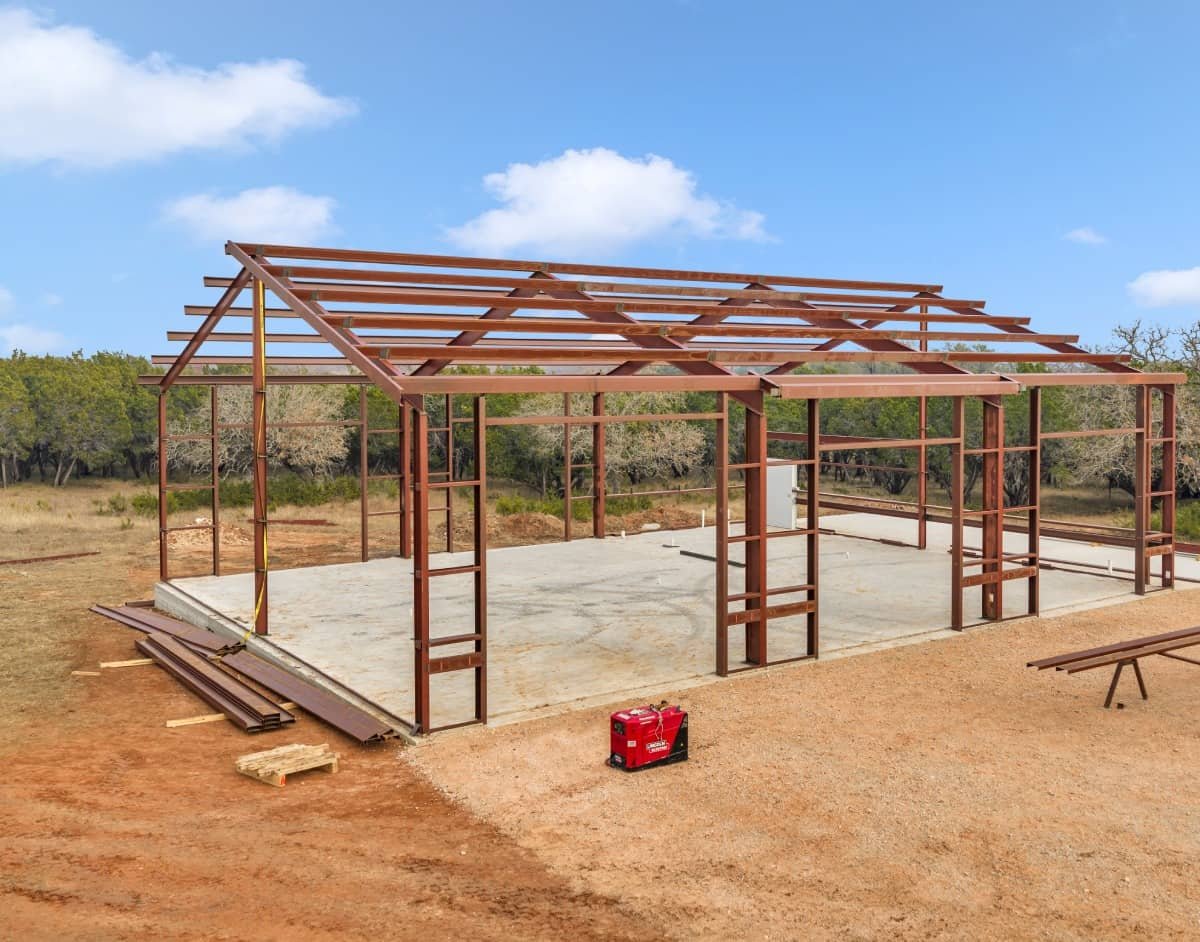
Hangars and Airport Buildings in Lufkin
An aircraft owner choosing a hangar is buying door clearance, floor space and a lease that lets the building stand for decades. We build hangars and airport buildings in Lufkin as pre-engineered steel, with clear-span frames, tall bifold or hydraulic doors and floors sized for the aircraft and the tow equipment that will use them.
Angelina County Airport is county-owned and open to the public, seven nautical miles southwest of downtown Lufkin, whose asphalt runway 7/25 measures 5,398 feet by 100 feet. An owner who leases a lot there should start by asking the airport manager three things: where the building may sit, how tall and wide it may be, and who pays for taxiway and utility connections. We take those answers, add the largest aircraft's wingspan and tail height, and set the clear opening before the frame is designed.
The hangar and a nearby shop or storage building often make a pair, and we price them together when owners ask. Steel lead time shapes the plan, because a hangar's door package and frame are often long-lead items. We tell you the date in writing, and we back-plan the foundation and permit work to meet it.
Industry, highway and rail around Lufkin
Lufkin's employers drive building demand beyond aviation. Poultry processor Pilgrim's Pride puts over 1,500 people to work in Lufkin, and Georgia Pacific also ranks among the city's ten largest employers. Plants like these buy maintenance shops, parts storage and equipment sheds, and they lean on contractors who can schedule steel erection around live operations.
Highway access also matters. Lufkin grew at the crossing of Highway 69 and Highway 59, a junction that the Lufkin Economic Development Corporation says carries roughly 30,000 vehicles a day. Freight can reach the city by road, and by rail too: the Angelina and Neches River Railroad covers around 20 miles inside the city and ties into the Union Pacific network. Warehouse and yard buildings near the tracks benefit from that connection, and our warehouse metal shells service covers dock-height doors and truck courts.
Where we build in Angelina County and nearby
We work on airport lots, plant sites, rural parcels and in-town lots. Each has a different set of constraints. On an airport lease, the airport owner controls the footprint and height. On a plant site, safety rules and shutdown windows control the schedule. On a rural parcel, the gate, the driveway and the soil decide how steel arrives and how deep the footing needs to be.
We can also work with owners who split time between cities. If you are comparing a site in Lufkin to one in Tyler or Longview, we can quote each with the same assumptions and show the difference in freight, labor and permit time. Owners with projects near the Houston area can look at our Conroe page for how we handle that market.
What to settle before you buy a hangar
A hangar is easiest to price when five questions are answered first. What is the aircraft's wingspan, tail height and length? How many aircraft will share the space? Will there be a shop, an office or a fuel storage area? Who owns the land? What does the lease require for fire protection and appearance?
The answers set door dimensions, frame width, slab thickness and the cost of fire suppression, if required. Hangar doors are often the most complex part, with large spans, wind loads and operators that must work in all weather. Our overhead hangar doors page describes the types and how they affect the structure above the opening. We also check height limits near the runway and the setback from taxiways with the airport owner.
Services that go with an airport building
A hangar shell is the start. Most owners also want a floor with a sealed finish, floor drains or trench drains, lighting, outlets, a small office and sometimes a restroom. Commercial operators add a maintenance shop, a parts room and a wash area. We coordinate those pieces as separate lines so you can add or remove them without changing the frame.
If you plan to keep several aircraft, our aircraft hangar work includes T-hangar style rows and larger clear-span bays. For an operator who needs a combined hangar and shop, a design-build approach keeps drawings, permit and construction under one schedule. Water supply is also relevant to site selection, since the Lufkin Economic Development Corporation reports that industrial sites can draw on 65.5 million gallons of surplus water per day, which helps users with wash-down or process needs.
Steel lead times and erection windows
Plan the order of events from the end. When do you need the aircraft inside? That date drives the final inspection, the door installation, the panel work, the frame and the foundation. We then find the steel delivery date and the permit date and see whether the pieces connect.
The long item is almost always the steel package, which is made to order after drawings are approved. We state the lead time at quote and update it when the fabricator confirms. Weather is the other variable. Rain delays concrete and wind stops lifts, so we build float into the erection plan. Tell us about any airport restrictions on equipment height, since a crane near a runway may need advance notice.
How we work with airport owners and tenants
We start by getting the lease or the rules in writing, so we know what applies. We then give you a layout, a price range and a schedule, and we flag any points that need approval from the airport owner. When drawings are final, we submit them with the permit package and keep track of comments.
During construction, we limit activity near active aircraft areas, keep equipment clear of taxiways and tell the airport manager about deliveries. We schedule, supervise and inspect the trade partners, and we finish with a walk-through of doors, lights, drains and fire equipment.
Aviation and the industries around it
Our aviation page describes the hangars, shops and storage buildings we price for private owners, flight schools and service operators. In Lufkin, the same frame types serve industrial users such as processors and manufacturers, who need maintenance buildings, equipment storage and distribution space.
Many owners work in more than one of these fields, such as a plant owner who also flies a company aircraft. We handle both as one project when it makes sense, so purchasing, scheduling and inspection stay in step. We also point out the differences, since an airport building has height and setback rules that a plant building does not.
Price a Lufkin hangar
Tell us the aircraft, the airport lease and the shop space you want. We will return a price range, a door plan and a steel lead time.
Common Questions
How wide should a hangar door be?
Wider than the aircraft's wingspan by enough margin to tow safely. We add clearance for a tug and the tail height, then confirm the opening with the door manufacturer.
Can I build on a leased lot at the airport?
Often yes, with the airport owner's approval. Ask about the lease length, size and height limits, appearance rules and who pays for utilities.
Do I need fire suppression in a hangar?
It depends on size, use and local review. The fire marshal and building department decide, and we raise the question during planning.
How long will the steel take?
We give you a lead time in writing at the quote and update it after drawings are approved. Doors and frames can be long-lead items.
Can a hangar include a shop?
Yes. A wall with a fire rating, ventilation and a separate door can divide the shop from the aircraft space.