Metal Buildings in Conroe, Texas
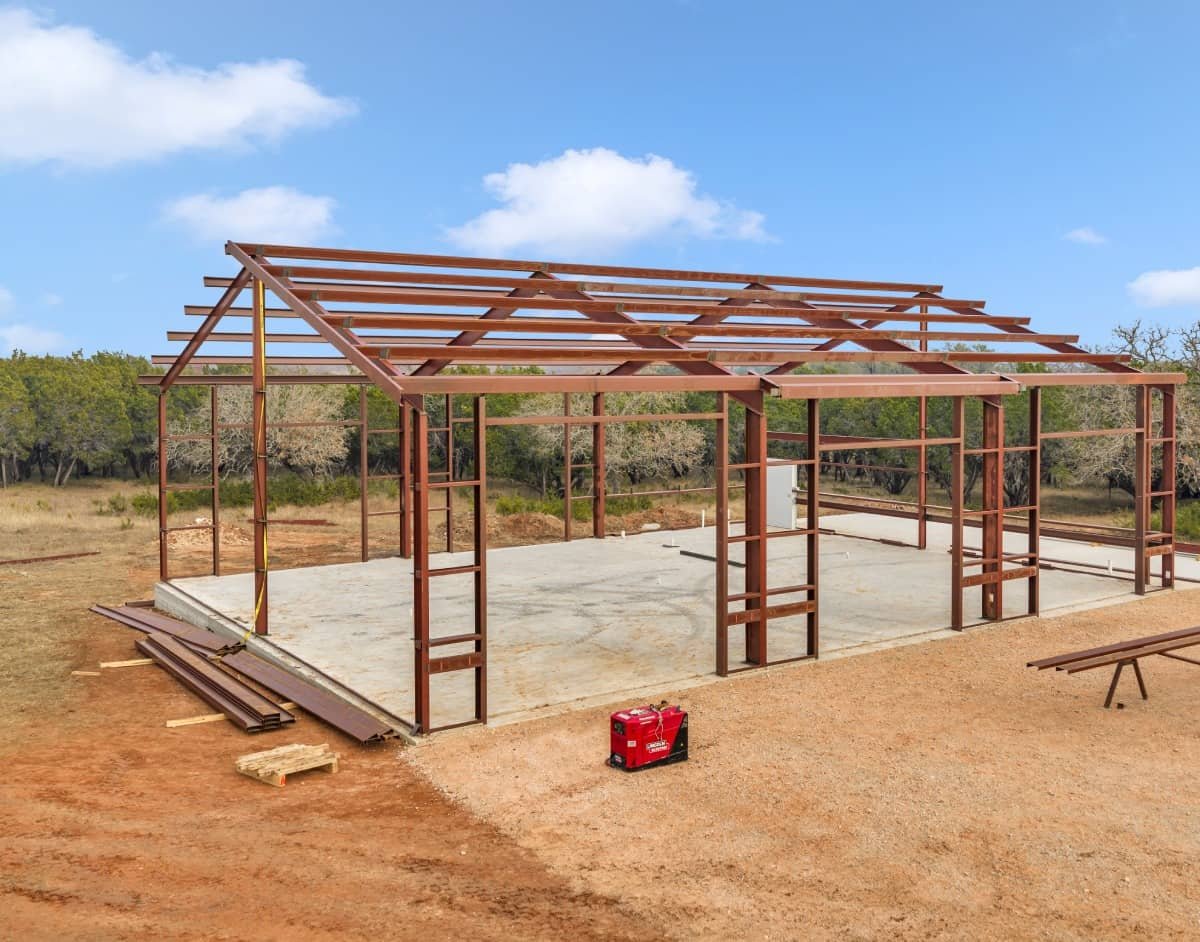
An owner buying a pad in one of Conroe's industrial parks can skip much of the usual site risk, and a pre-engineered steel building lets that owner skip most of the construction risk too. We put up shops, warehouses and light-industrial buildings in Conroe on a fixed scope, with the foundation, frame, panels and finish handled as one job and the steel lead time stated before you sign.
The parks do part of the work for you. The Conroe Economic Development Council describes Conroe Park North as a 1,655-acre industrial park on FM 3083, two miles east of I-45, with four-lane concrete streets, city water and sewer, more than 40 companies and over 3,000 employees. Deison Technology Park is a 248-acre park off FM 1484, four miles east of I-45 and close to Conroe-North Houston Regional Airport. Utilities at the lot line, truck-ready streets and nearby neighbors with similar buildings mean fewer unknowns in the budget, which is exactly what a steel building price depends on.
What pushes a Conroe building price up or down
In a developed park, the cost drivers shift away from utilities and toward the building itself. Clear height, door count, insulation and floor thickness decide most of the number. If the lot has water and sewer at the street, you avoid a long line extension, and the building owner can concentrate budget on the shell and fit-out.
We watch three line items closely. First is the slab: truck and forklift traffic needs reinforcement and well-placed joints. Second is the roof: a standing seam system costs more than a through-fastened one but removes a maintenance chore. Third is insulation: a warehouse with people working in it needs a plan for summer heat, and a vapor-retarding blanket or insulated panels are the two usual options. We price each so you can choose by budget and use.
Distribution, aviation and light manufacturing
The Conroe EDC lists an 858,000-square-foot distribution center built on 72 acres and a freight service center on 25 acres, both in Conroe Park North. We build at a smaller scale, but the same logic applies to warehousing and distribution owners: trucks need turning room, docks need level aprons, and the building needs a sprinkler plan that matches the stock.
Near the airport, aviation users ask about hangars and maintenance shops, and manufacturers want clear-span space for assembly. A technology park owner might want a steel shell with an office front. We build all three shapes with the same four-step process of foundation, frame, panels and finish.
Pairing the shell with the right extras
Many Conroe owners combine a warehouse metal shell with an office build-out and a mezzanine. Others add building expansions a few years after opening, when sales grow. Planning for that addition from the start is cheap: we leave one end wall unbraced for a future bay, and we stub utilities toward the expansion area.
If you already own an older building, our re-skin and retrofit work replaces worn panels and fasteners, and it can add insulation and new doors without disturbing the frame. It is often the cheapest way to extend a building's life.
Conroe and the I-45 corridor to the south
Wikipedia states that Interstate 45 links Conroe to Houston, 40 miles to the south, and that Texas Loop 336 circles the city. It also notes that BNSF operates the Conroe subdivision, an east-west main line from Silsbee to Navasota, and Union Pacific runs the Palestine subdivision north from Houston, with the two lines crossing at a diamond in downtown Conroe. For owners who ship by truck, I-45 and the loop decide where to build. For those with rail needs, the intersection shapes where spurs may be possible.
We also build south in The Woodlands and west toward Cypress, so we can compare land and permit conditions between them for you.
Keeping a job site safe near traffic and airports
An erection site is a place where steel hangs overhead and wind matters. We set exclusion zones, tie off at height and plan crane picks around power lines. Near an airport, we also check height restrictions and notice rules before any crane is raised. A tall crane near an approach path needs coordination, and we raise it early so it does not become a stop-work order.
We hold a pre-task talk each morning and stop for wind that exceeds the limit set for the lift. Owners get the same safety expectations on a 6,000-square-foot shop as on a larger building.
Pad preparation and building placement
Industrial park pads are often graded to a rough level, but finished floor, drainage and truck courts still need a careful design. We confirm the pad elevation against the park drainage plan, check soil, and set the building so trucks can turn without backing across a public street. Easements and setbacks matter too, since park covenants often set minimum building materials, landscape and screening.
Read the covenants early. Some require a masonry or metal-panel wainscot facing the street, and others limit signs or outdoor storage. We build those elements into the design rather than add them later.
Why a mid-size owner can build here
Parks that already host more than 40 companies are proof that mid-size owners can operate here. The mix of national distribution and local manufacturers means a supplier ecosystem exists nearby: concrete, electrical, fire protection, truck repair. That shortens the lead for small items and gives your building a bench of local trades to draw from.
It also helps with timing. A concrete finisher who works in the park every week knows the inspector, the haul routes and the pour windows, and an electrician who has pulled permits for neighbors knows what the city wants to see. We lean on those local relationships to keep small jobs moving, and we tell you plainly when one trade is the limiting factor. Pricing a building here is therefore less about unknowns and more about the choices you make on height, doors and finish.
Start a Conroe building quote
Send us the park or the address, your use and your size range. We will check covenants and utilities, then price the building in steel.
Common Questions
Does buying in an industrial park change the building design?
Usually it adds rules. Park covenants can require facade materials, landscaping and setbacks. We read them first and design the building to comply, which avoids redesign during approval.
How tall should my building be for racking?
It depends on your racking and sprinkler design. Many owners choose 24 to 32 feet clear. We ask for the rack layout and talk to the fire protection contractor before fixing the eave height.
Can I add on to the building later?
Yes, if it is planned. We design an end wall that can be removed, and we size the foundation and utilities to suit. An addition built this way is much cheaper than an unplanned one.
Is rail service realistic for a small building?
Only if the park or an adjacent owner offers a spur. It affects dock layout and site cost, so ask early. Most small owners choose truck-only designs.
How do you handle building near an airport?
We check height limits and notice requirements before bringing a crane to site, and we plan the lift sequence around them. That avoids delays and keeps the crew safe.