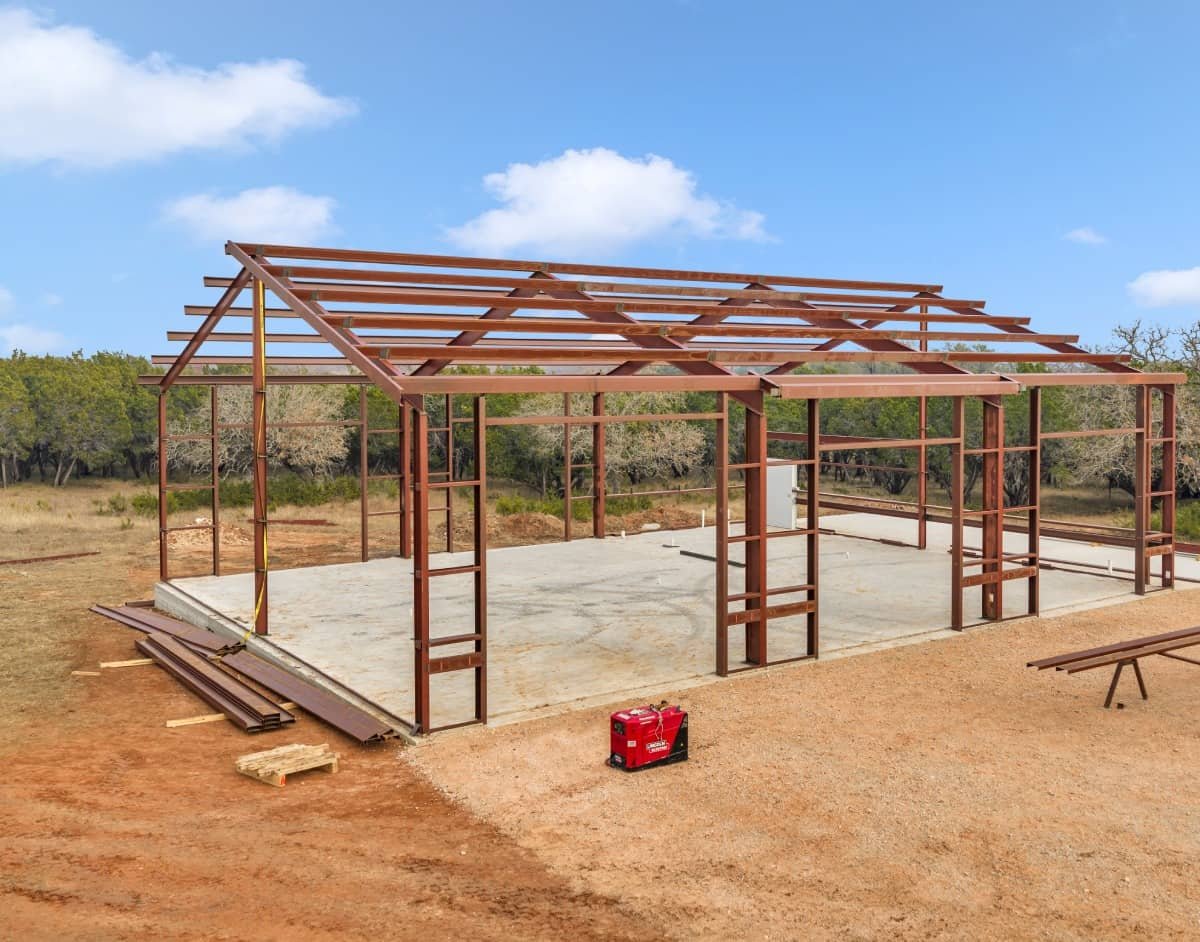
Metal Buildings on the Texas Gulf Coast LNG and Petrochemical Corridor
When the construction army leaves an LNG site, a smaller permanent crew stays behind, and that crew needs maintenance shops, spare-parts warehouses and contractor yards close to the fence line. We build those: pre-engineered steel buildings for the service companies, fabricators and suppliers who live on the Texas Gulf Coast LNG and petrochemical corridor, from Sabine Pass in the east to Corpus Christi in the south.
The U.S. Energy Information Administration reported on April 23, 2026 that an LNG project at Sabine Pass achieved first LNG production in March 2026 and shipped its first cargo on April 22, 2026, with three trains of 0.7 Bcf/d nominal capacity each (2.0 Bcf/d for the full facility), Train 2 expected in the second half of 2026 and Train 3 in the first half of 2027. A project in that stage moves from construction to operations in steps, one train at a time, which means a long tail of commissioning, turnarounds and maintenance, and a long tail of buyers who want a building they can occupy on a contract.
One working strip across the counties
The corridor reaches across Jefferson, Brazoria and Nueces counties and the stretch of coast between them. Owners usually pick a base by where their customers are and how quickly their trucks can reach the gate. We build around Port Arthur and Beaumont in the east, around Freeport in the middle and near Corpus Christi in the south.
Each stretch has its own soils, flood zones and permit rules, but the building itself looks similar from one end to the other: a clear-span shop with tall doors, a parts room, an office and a lay-down yard. The pace of work on this coast also leaves a short list of crews who can erect a building well and quickly. We book erection crews in a way that lets us start on the date we promise, and we tell you when we cannot. We carry the same discipline across the coast and adjust the foundation and flood elevation to suit each lot.
Why one consistent approach matters on a corridor job
A contractor who manages a different erector differently in every town gets different results in every town. We manage erection with the same methods and checklists from site to site. For a service company opening yards in two or three coastal cities, that consistency matters: the same door detail, the same slab joints, the same trim, repeated.
We also keep the engineering package consistent. If you need a second building in another county, we can reuse the design with changes for wind, flood and soil, which saves design time and cost.
Services that suit permanent operations
Operators of LNG and chemical sites typically need buildings with more than basic enclosure. Our insulated metal panel work covers temperature-controlled parts rooms and offices. Structural steel erection supports equipment platforms and pipe racks beside the building. High-bay crane-ready buildings cover heavy maintenance shops.
We recommend choosing these in the first design meeting, since each one affects the frame, the foundation and the electrical service. A bridge crane, for example, changes the column size and the footing under it, and a mezzanine changes the slab. Nothing on that list is hard to build when it is on the drawing, and every item is costly to retrofit once the building is standing.
Flood, wind and corrosion along the coast
Three conditions follow the corridor from end to end: storm surge and rainfall flooding, high design wind, and salt air. They shape every building. We set finished floors at or above the flood requirement, design frames and cladding for the wind speed at the site, and specify coatings and fasteners for a corrosive environment. These choices cost a little more at the start and a lot less over the life of the building.
Owners ask whether the flood and wind standards for a plant vendor's shop are the same as for the plant. They are not always the same, since a plant may design to its own engineering standards. A vendor's building is permitted as an ordinary commercial building, and the local official sets the requirement. We build to that standard and recommend going a step above it when the cost is small, such as an extra foot of floor height.
Utilities and site access also vary. Some sites have plenty of power and water; others need an upgrade. We ask early and put the answers in the schedule.
What the paperwork looks like
Texas has no single commercial building code that applies uniformly. Municipalities adopt editions and amendments locally, and some rural areas have limited review. We confirm the rules for each site, produce stamped engineering and keep the permit package complete. For buildings with public access, state accessibility review applies above a dollar threshold, and we plan for it.
Industrial plants also have their own contractor rules. We ask for insurance, safety and access requirements before pricing, since they affect labor and timing.
Building for a customer who may change
Projects of this size change. A schedule slips, a train moves up, a contract ends. Our approach is to design buildings that tolerate that: standard sizes, flexible interiors, expandable end walls and reusable components. If your customer's work ends, the building should sell or lease easily. If the work expands, the building should grow.
The Enerdata service reported on April 1, 2026 that production started from the first of three LNG trains at the 18 million tonnes per year Sabine Pass project. Every additional train adds commissioning work, inspections and operating crews, and a service business that planned its building to expand is ready for each stage. Farther east, a final investment decision on a Port Arthur phase of about 13 million tonnes per year, reported by LNG Industry on September 24, 2025, points to still more years of work on the same stretch of coast.
Corridor customers
Our buyers are mostly in manufacturing and the trades around it. Some are in warehousing and distribution, supplying spares and consumables. A few are public owners such as port districts and municipalities with maintenance needs. LNG Industry reported on June 25, 2025 that two midscale trains of over 3 million tonnes per year were approved next to an existing stage at Corpus Christi, with total site capacity expected to exceed 30 million tonnes per year later this decade, and that shows how long the build cycle on the corridor can run.
Plan a corridor building
Tell us which counties you serve and what you need inside. We will propose a building design that repeats across sites with the right changes for each.
Common Questions
Do I need a building at each location?
Not always. Many service companies operate from one hub and send crews out. We help you compare the cost of one large yard against several small ones.
Can the same design be used in two cities?
Yes, with adjustments. The layout can repeat, but wind speed, flood elevation and soil need to be checked for each lot.
How long do I need to commit to a building?
That is a business decision, but we advise building something you can sell or lease. Standard sizes and details help resale.
What does salt air do to a steel building?
Without good coatings and hardware it accelerates corrosion. With the right materials and routine rinsing it lasts a long time. We recommend a coastal specification.
Can you coordinate permits across jurisdictions?
Yes. Each site has its own rules, and we track each one separately and report on status.