Metal Warehouses and Shops in Eagle Pass and Del Rio
Truck stops, speculative warehouses and shops that serve a pilot-training base all lean on the same steel skeleton in Eagle Pass and Del Rio, and we erect it for owners who want a firm price and a delivery date. These are two small border-country markets about a county apart, with different customers but shared building problems: long distances, few local suppliers and a need to keep the job moving once the crew arrives.
In Eagle Pass, freight is the engine. A Realty News Report article from February 2025 described the 1,761-acre Empire Industrial Park, with river frontage, seven warehouse land parcels under contract, a 136,000 square foot speculative warehouse expected within months and a 10-acre truck stop sale fronting El Indio Highway. In Del Rio, a different kind of demand dominates: Wikipedia describes the Air Force base at Del Rio as the largest pilot-training base in the Air Force and the area's largest employer, which supports service shops, storage and light commercial buildings in town.
We handle both patterns the same way. A clear-span warehouse frame, panels that suit the weather, doors that fit the vehicles that will use them and a slab matched to the load. The details of the price come next, and for a freight-minded owner the warehousing and distribution page covers dock layout and floor choices in more depth.
How we reach two border-country markets
Maverick and Val Verde counties are far from the large metros, so mobilization is a real line in the budget. We plan crews, crane and material deliveries as one trip when we can, and we tell you what portion of the price is travel and lodging. Owners are better off knowing that number up front than finding it buried in a lump sum.
If you also operate along the border, a project in Laredo and one in Eagle Pass can share drawings and standards, and owners comparing small Texas markets often put these towns next to San Angelo, where a different base supports a different mix of work. We use the same engineering approach from one site to the next, and we will tell you which parts of a prior design carry over and which must change because of a new soil report or local rule. For a first-time owner, that repeatability is a way to keep price and schedule predictable.
Trade volume, a proposed crossing and why it matters
A May 2026 article citing trade data says Eagle Pass handled $3.77 billion in total trade in March 2026, down 9.23 percent from a year earlier, and was the nation's tenth-largest border crossing by trade volume that month. Numbers like that swing from month to month, so we would not size a building on one data point. We use them as a sign that the crossing is large, active and subject to policy shifts.
A July 2026 radio report described a proposed trade crossing near Eagle Pass with one span for trucks and one for trains, with the county saying it would buy up to 65 percent of the developer's stake and the developer saying groundbreaking would occur by the end of the year. The proposal was also described as the subject of a local dispute. Treat it as a possibility, not a plan. We would suggest that an owner buy land and build for existing operations, and let a future bridge be an upside.
Distance, deliveries and what we confirm first
Out here, the quality of the plan before mobilization matters more than anywhere. A missing anchor bolt, a short load of panels or a late delivery truck can stop a crew for days. We check the delivery list against the drawings twice, inspect the foundation before steel arrives and keep a small stock of fasteners, sealants and trim on the trailer.
Our own scheduling follows the same caution. We prefer to receive steel in the order it will be erected, with each bundle tagged by bay, and we ask the foundation contractor to confirm anchor bolt locations against the shop drawings in writing. If a survey error is found at that stage, it is fixed with a template and a few hours of work. If it is found after the frame is standing, it can cost days and a crane. That is why we spend the first morning on a remote site checking dimensions rather than lifting steel.
We also confirm the practical items: where trucks can enter, how wide the road is, whether power and water are on site and where the crew can park and stage material. Truck-stop and fuel-island work comes with its own rules for fire separation and drainage, which the engineer and the fire official sort out before drawings are final.
What we manage and what we subcontract
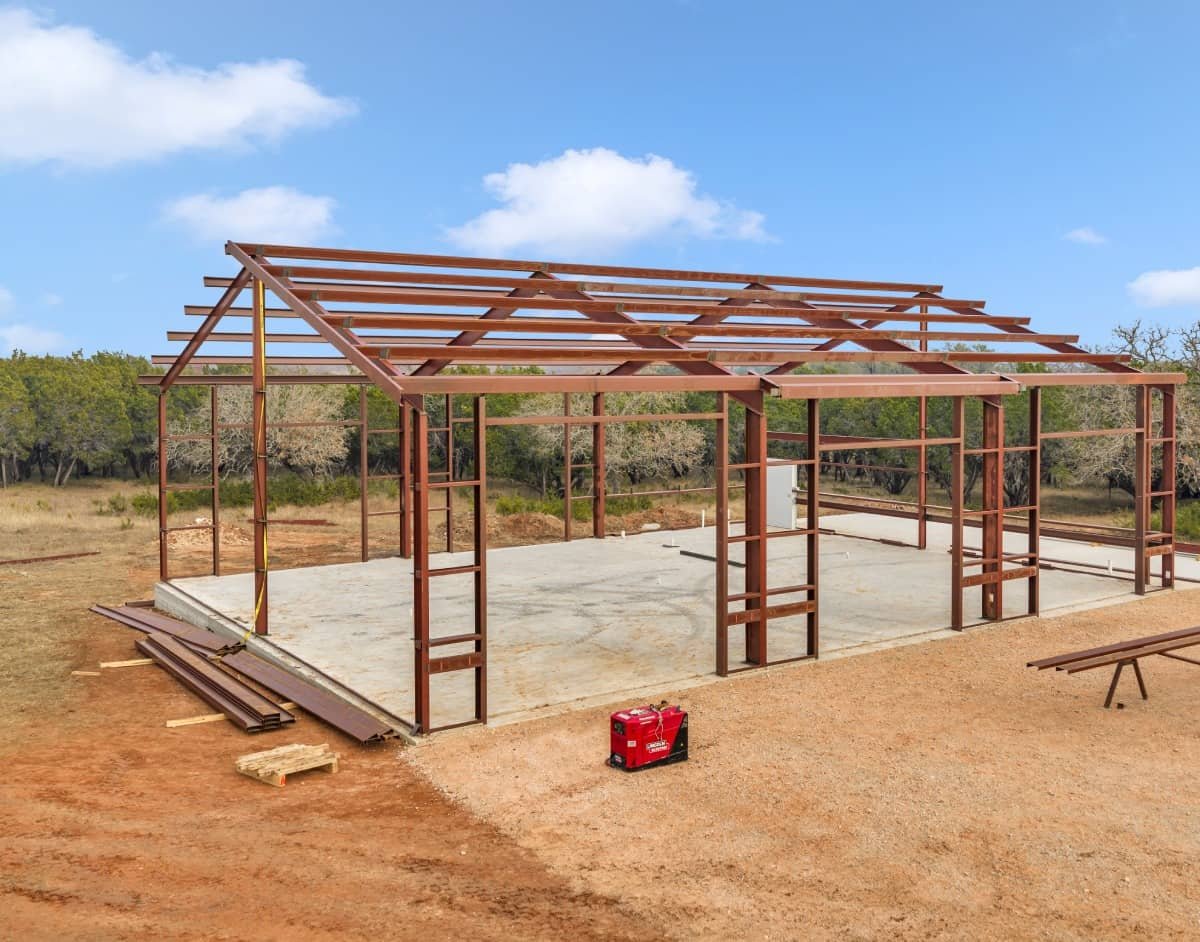
The erection crews we schedule erect the structure, install the panels, trim and doors, and set the anchor rods and base plates when we are responsible for the foundation interface. Our structural steel erection work extends to canopies and mezzanines when a truck stop or a shop calls for them. Owning those tasks means fewer handoffs on a remote site.
We subcontract the other trades, such as electrical and plumbing, and we schedule them early so they do not hold up the inspection. For existing buildings that need work, the re-skin and retrofit crews we coordinate can renew panels and trim on older metal structures.
Heat, wind and working outdoors
Summer heat is a safety issue on a steel erection job. We schedule heavy lifting for the cooler part of the day, require water and shade at the work area and build rest breaks into the plan. Wind is the other limit: we stop lifting when gusts exceed the safe range for the panels or frame and secure loose material before leaving the site.
Public and base-related work may add badge, background-check and site-access requirements. Ask early which apply to your project, because they affect how many crew members can be on site and when. The municipal and public works page describes how we handle review and paperwork on government projects.
Talk to us about your Maverick or Val Verde County site
Send us the parcel, the use and your target date. We will tell you what the steel lead time looks like, what the foundation needs and how much travel and crew housing we have priced in.
Common Questions
Is it worth building speculative warehouse space in Eagle Pass?
It can be, but only if you can carry the building through slow months. The reported March 2026 trade figure was lower than a year earlier, which shows how volume moves. Build a shell that can serve more than one tenant, with standard dock positions, and avoid special features that only one user wants.
How much extra does a remote location add?
Travel, lodging, mobilization and longer delivery runs add cost, and the amount depends on crew size and project length. We show it as its own line so you can compare it with local alternatives, if any exist. A larger building spreads the fixed travel cost over more square feet.
Can a truck stop be built with a metal building?
Yes for the main building, canopy and shop. The fuel system, tanks and drainage are separate engineered scopes with their own approvals. We coordinate with those trades and design the building around the layout of the fuel island and the truck lanes.
Do you build for military support or base-adjacent work?
We build for private owners near bases, such as vendors, storage and service shops. On-base work follows federal procurement rules, which are different. Ask us about the private side, and we will tell you plainly what we can and cannot do.