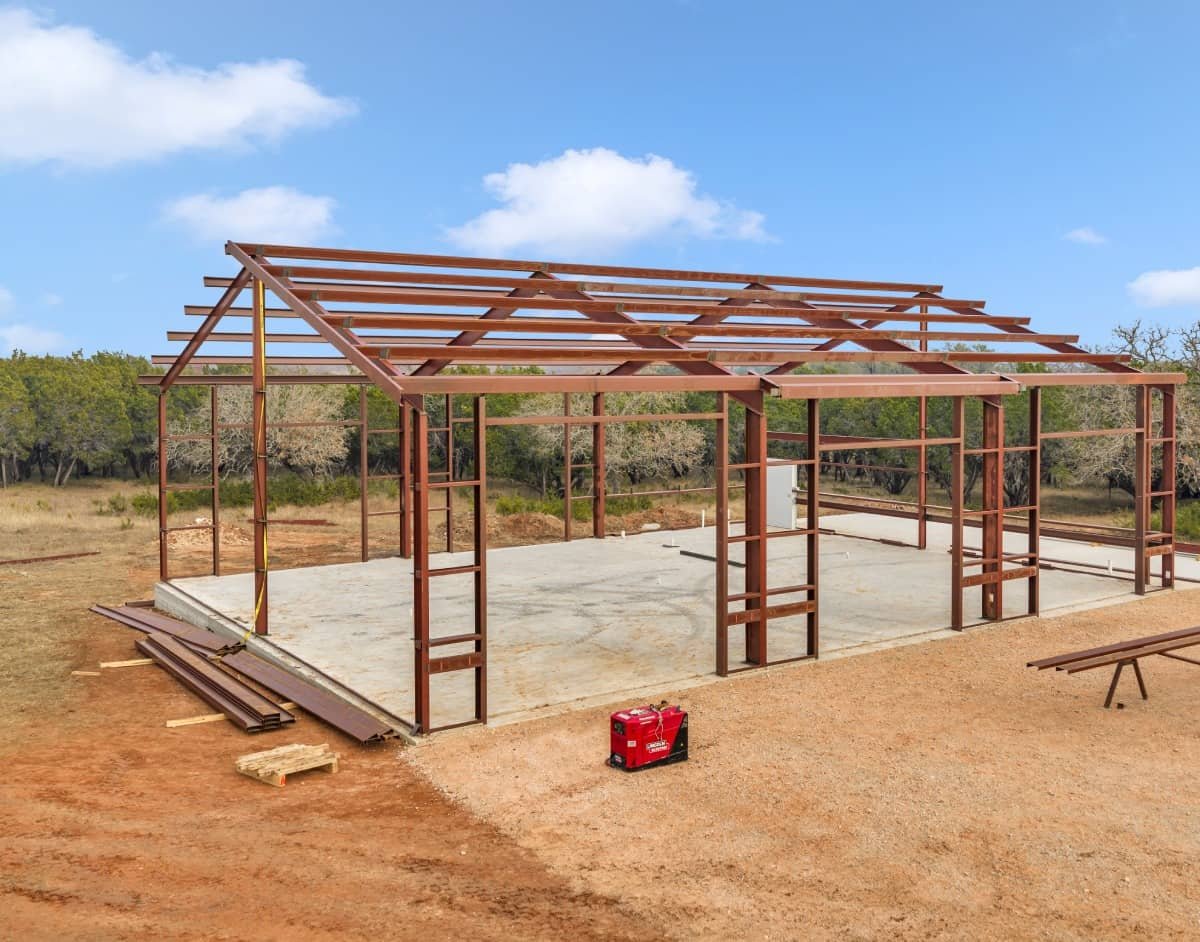
Ground-Support and Cargo Buildings Near DFW Airport
Ground-support equipment needs a home near the gate, and a steel building is the practical way to provide it. Tugs, loaders, belt units, de-icers and fuel trucks need covered storage and a maintenance bay close to the ramp, and cargo handlers need dock space for pallets. We build pre-engineered buildings for those uses in and around DFW Airport, working inside the rules that govern construction on and near an active airfield.
The airport's own facts page puts the numbers in scale. It covers more than 26.9 square miles, with five terminals, over 160 gates and seven runways, four of them 13,400 feet long. It serves over 86 million customers a year, has 21 cargo airlines offering freighter service, and reports a total annual economic impact of over $78 billion including 684,000 jobs supported. A separate reference page reports 858,952.3 tons of cargo handled in 2025. For a cargo-support building owner, that tonnage is the customer base.
The airport owns about 17,200 acres across parts of Dallas and Tarrant counties adjoining Grapevine, Irving, Euless and Coppell. Land inside the fence is leased; land outside it is private and zoned by the neighboring city. We build on both, and the process differs.
Inside the fence and outside it
Inside the airport boundary, construction follows the airport's own design and construction standards, tenant improvement procedures, security badging and operations rules. The airport reviews the drawings in addition to any building authority that applies. Outside the boundary, the adjoining city issues the permit, and airport height and lighting restrictions still apply nearby.
Texas sets the International Building Code as the floor for municipal commercial codes, with local amendments allowed, so on a private parcel we confirm the edition with the city. On airport land we obtain the airport's requirements in writing before we price. Either way, we build the review time into the schedule and prepare a complete first submittal.
Equipment storage, cargo and maintenance
A ground-support building is usually a wide clear-span shell with large doors on two sides, so equipment can drive through. Charging or fueling areas, spill containment and ventilation are part of the design. Cargo support buildings need dock-height floors, truck courts and enough clear height for racking and forklifts.
Aircraft maintenance and parts buildings sit between those two. Our aircraft hangar work covers the large-door, tall-clearance side, and our logistics and fulfillment page covers the cargo side. For owners who need both, a combined shell can reduce cost.
Security, badging and crane approvals
Workers on airport property need background checks and badges, and vehicles may need permits and escorts. Materials arrive through controlled gates. We start the paperwork as soon as the contract is signed, because a crew that cannot enter is a crew that costs money. A crane or lift on the site may need aeronautical review before it can be raised, depending on its height and location.
We also keep the job clean. Debris on a ramp or taxiway is a hazard to aircraft, so we control loose material, cover loads and sweep daily. A written safety and foreign-object-debris plan is part of our submittal for airport work.
Aviation and logistics tenants
The airport is the largest hub for a major passenger airline, and its cargo activity supports forwarders, handlers, truckers and warehousing. The surrounding highways, State Highway 183 to the south and State Highway 114 to the north, and rail connections including the Orange Line, TEXRail and the Trinity Railway Express, tie the airport to the region. A tenant's building location often depends on how fast its trucks reach the cargo area.
Our aviation and warehousing and distribution pages give more detail on both sides of the market.
What airport work costs
Airport work carries a premium for security, badging, review time and restricted access. We do not hide it. The quote lists the extra supervision, the escort time and the schedule effect, so you can compare an airport site with a private parcel nearby. Sometimes the private parcel wins; sometimes the location inside the fence is worth the premium.
Utilities matter too. Power, water and fire service are available at many sites, but tie-ins can require airport approval and outage windows. We plan them with you.
Planning around operations
Airport tenants often must keep operating while we build next door, so the schedule is shaped by the operator's calendar. We schedule noisy work, crane lifts and road closures for low-traffic periods, and we coordinate with airport operations for any work near the ramp. Steel and concrete deliveries are arranged to arrive through the approved gates at approved times.
For a building on private land nearby, the schedule is simpler, but it still follows permit review, foundation, steel delivery, erection and finishing. Either way, we give you written dates and tell you which depend on the airport, the city or the mill. A hangar or ground-support building can often be turned over in phases, with the shell first and the interior later. Tenants who lease their space often need the building to meet the landlord's turnover checklist, and we ask for that list at the start so the punch list matches it. We also schedule a final walk with your operations staff before the keys change hands, so the first shift starts with doors that work and lights that come on.
Design for the equipment
We start with the equipment list: the largest vehicle, its height with beacons and masts, its turning radius, and any charging, fueling or wash needs. A baggage tug is small, and a de-icer is not. From that list we set door size, eave height, slab loads and drainage. For cargo, we start with pallet height, forklift type and dock spacing.
A good building is one the crew can use at three in the morning in the rain. That means lights that work, floors that drain, doors that open quickly, and ventilation where engines run. We discuss these details with the people who will use the building, not only with the person who signs the contract.
Nearby areas
Part of the airport lies in Irving, so many owners also look at Irving, and others compare Grand Prairie or Alliance to the north.
Start an airport-area building
Tell us the use, the aircraft or equipment involved, and the tenant or lease terms. We will return a concept, a price per square foot and a schedule that accounts for airport review and security.
Common Questions
Can a private company build on airport land?
Yes, as a tenant under a lease with the airport, subject to its design and construction standards. We ask for those standards in writing before pricing.
How long does badging take?
It varies, so we start immediately after signing. We tell you the expected duration and plan work accordingly.
Is a private parcel nearby simpler?
Often, because only the city reviews it, but height and lighting restrictions near the airfield still apply.
What about foreign object debris?
We keep a written plan to control loose materials, sweep daily and secure loads. Airport staff may inspect.