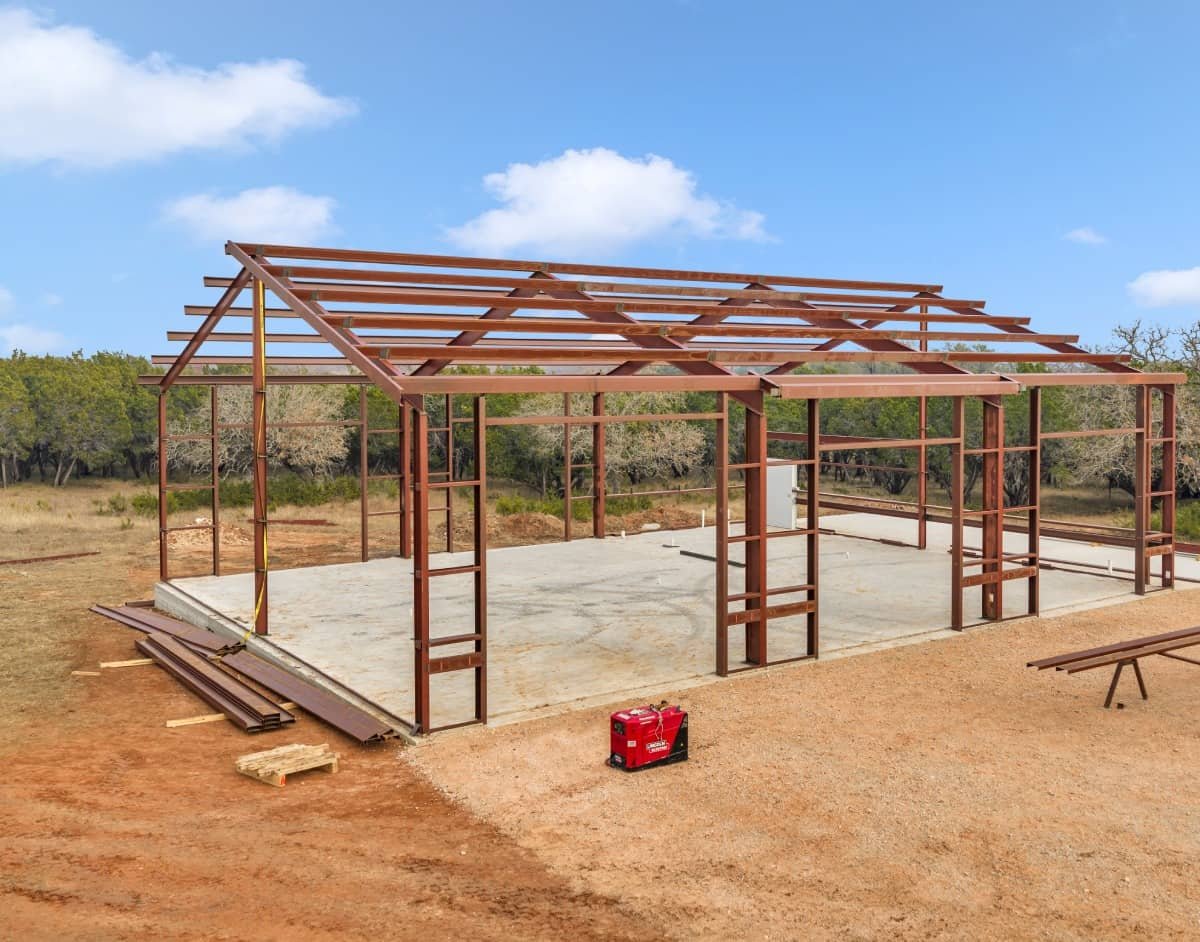
Metal Buildings in Texarkana, Texas
Truck terminals, tire and packaging suppliers and an Army depot with more than 1,400 buildings all share one problem: they need weather-tight steel structures built fast and priced clearly. We build those for owners on the Texas side of Texarkana, from cross-dock and truck shops to maintenance bays and storage buildings, and we write the cost per square foot and the steel lead time down before the work starts.
The location is a junction. Texarkana sits at the junction of I-30 and U.S. highways 59, 67, 71 and 82 in extreme northeastern Texas. I-30 passes through on the north, and Loop 151 runs along the west side, forming part of the Texarkana Loop, with I-369 sharing the western portion of Loop 151. A trucking company on the loop can serve several directions from one yard, and that is why we start every Texarkana conversation with the truck path.
Steel also fits the way trucking companies grow. They add a bay, then a wash, then a second shop, and each step should not require tearing out the last one. We plan the first building so the next one can attach to it, with the utilities, drainage and fire access thought through ahead of time. Owners in this market often compare steel to older masonry or tilt buildings, and the numbers usually favor steel for shops and storage. We show the comparison honestly, including where steel is not the best choice.
Shops, terminals and storage built to work
A truck shop needs tall doors, a clear span for lifts, a floor with drains and good lighting. A cross-dock needs a long, narrow footprint with doors on both sides and a slab built for forklift traffic. A storage building for parts, tools or tires needs a dry floor, ventilation and racking height. Each of these is a variation of the same rigid frame, and each has different costs. A shop with a 16 foot door and a 20 foot eave needs less steel per square foot than a cross-dock with a 28 foot eave and heavy slab. Trench drains, oil separators, compressed air lines and exhaust ventilation are add-on items, and we price them one at a time so you can see which ones pay for themselves in saved time and fewer cleanup headaches. If you run a mixed fleet, ask us about two door heights in one building.
Our truck terminal and cross-dock page lists the options we most often price. For maintenance work, the rigid frame erection sequence applies directly, and the buildings can be insulated, vented and lit for year-round use.
Reusing, re-skinning and building beside what is there
A large depot-level maintenance facility was activated in 1941 as an ammunition storage facility. It covers 15,375 acres about 18 miles west of Texarkana, with more than 3,500 employees and about 8,000,000 square feet of floor space. We mention it because the scale of that campus is a reminder that much of the region's building stock is old. Roofs fail, walls rust and doors no longer fit modern equipment.
For private owners with older steel buildings, a re-skin or retrofit is often cheaper than replacement, if the frame is sound. We inspect columns, rafters, connections and foundations first. Where the old frame is not worth keeping, new steel on the existing slab can save weeks, provided the slab is in good shape and fits the new column layout.
Manufacturing and packaging suppliers
In the city's 2021 report, a tire manufacturer employed 1,793 people and a packaging manufacturer 829, alongside the depot and tenants at 2,225. Texarkana is a smaller market than Tyler to the southwest or Dallas to the west, and the buyers know each other. A well-built shop gets noticed. A poor one gets talked about. We take that seriously. Our Tyler page shows how we work in a similar mid-size East Texas city. Plants like those draw suppliers who need warehouse space, maintenance contractors who need shops and haulers who need yards. The Texas city of Texarkana had a 2020 census population of 36,193, so it is a small market where one well-sited building matters.
Buyers here tend to be practical and price-aware. They want the building in service before their next contract and the budget in line with the numbers they gave their bank. We keep that in mind when we recommend an insulated or a bare building. Heating and cooling bills in a steel building without insulation can run high, and a worker who is comfortable is a worker who stays. A simple blanket under the roof and in the walls often pays for itself within a few seasons, and we can price spray foam or insulated panels for owners who want a higher level.
Who we build for here
Warehousing and trucking are the most obvious. See our page on warehousing and distribution. Manufacturing support comes next, and our manufacturing page shows how we frame the buildings. Agricultural and timber-related operators in the surrounding counties also use steel for equipment storage and work areas.
Public buyers such as school districts, cities and counties buy shops, bus barns and storage. If you are one, the Texas Comptroller's statewide procurement division connects vendors with state purchasers, and local entities follow their own bid rules. We provide scopes and prices that fit them, with unit prices on the items a bid form asks about. Public buyers also care about warranty language, so we spell out what the manufacturer's panel finish warranty covers and what is excluded.
A calendar that respects your operations
Working next to an active terminal or plant means scheduling around shifts, deliveries and peak days. We plan site access, lay down areas and crane picks to avoid blocking your trucks. Steel is fabricated while foundation work proceeds, and erection comes after the slab cures.
Our Longview page describes similar scheduling on the I-20 corridor to the south and west. We tell you the lead time on steel up front and notify you if it changes. If your shutdown season is fixed, such as a plant outage, we work backward from that date and order the building package early enough to meet it. A change after the steel is released is expensive, so we ask you to confirm the door sizes, bay spacing and eave height before release.
Price a Texarkana shop, terminal or storage building
Send us your truck count, door sizes and floor loads. We will return a package price, site estimate and steel lead time.
Common Questions
How big should a truck shop be?
Size it for your longest vehicle plus room to walk around. A single-bay shop for a tractor and trailer is often 25 by 80 feet or more. Multiple bays, parts rooms and offices add up fast. We help you test a layout before ordering steel.
Can you build a cross-dock on the Loop 151 corridor?
Yes, subject to zoning, access and drainage. A cross-dock needs door spacing, truck court depth and trailer parking that often drive the lot size. We check them against the property before you buy.
Is re-skinning an old building worth it?
If the frame is sound and the foundation is in good shape, usually. A new roof and wall system costs a fraction of a replacement building and can be done in phases. We inspect before we quote.
Do you build only on the Texas side?
We work in Texas, and our Texarkana work is on the Texas side of the city. We confirm the jurisdiction and permit authority for each lot.
How do I plan for a plant expansion?
Frame the building with a removable end wall and design the foundation for it. Adding a bay later costs much less than starting over. We lay out utilities and drainage so the extension fits.