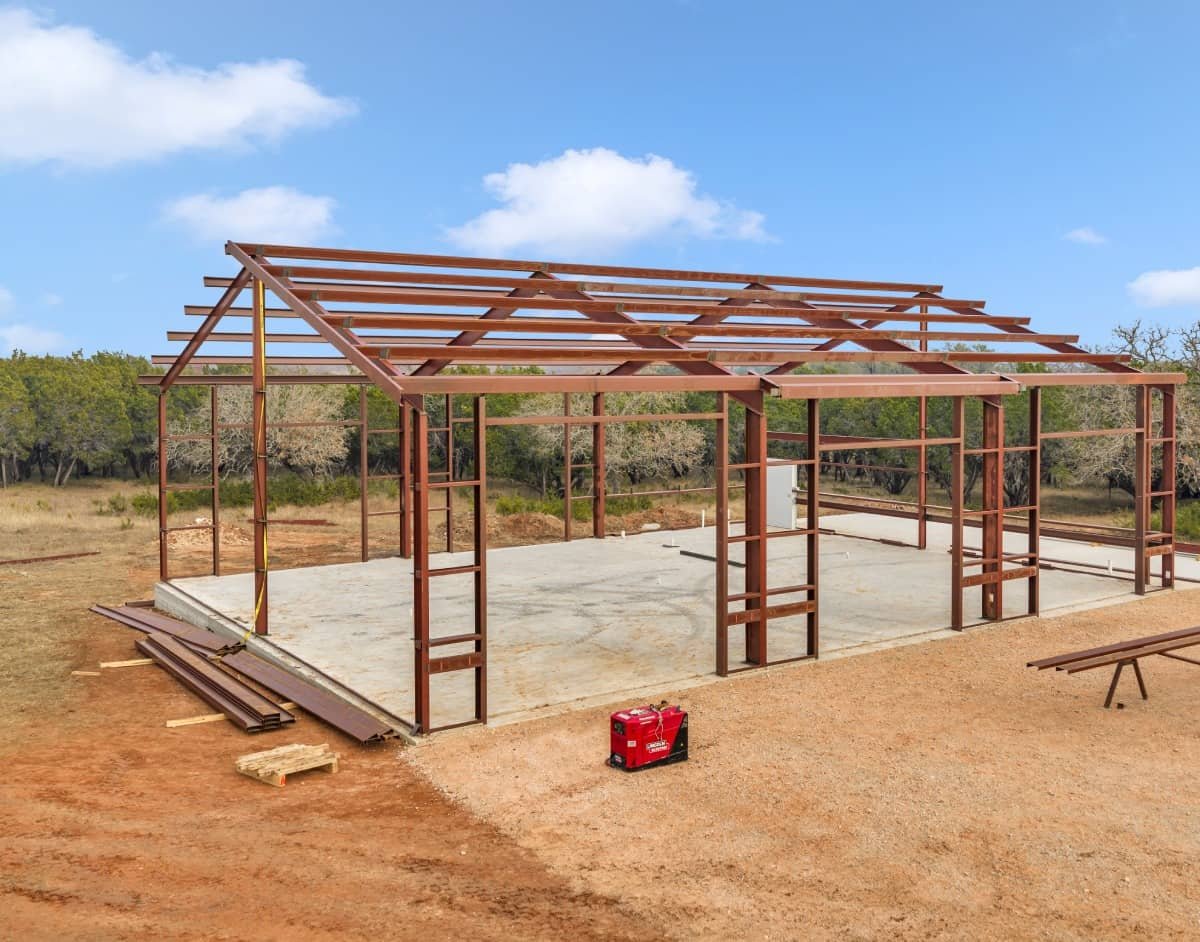
Metal Buildings in Temple, Texas
Clay under the slab and a rail line beside the lot decide most Temple projects before color or trim ever comes up. We build rigid frame shops, warehouses and service buildings here, and the first conversation is usually about foundation depth, not color. Prairie clay moves with moisture, so a quote that skips that line is a quote that will come back as a change order.
The location makes the building worth the care. Temple sits on Interstate 35, roughly 34 miles south of Waco and 68 miles north of Austin, so a distribution or supply building here can reach both ends of the corridor on the same day. That is why owners looking at a metal warehouse or a flex building in this part of Bell County care about a clean dock layout and a firm delivery window as much as the price per square foot.
Here is what that means in practice. We give you a number per square foot for the building package, a separate line for the slab and site work, and a lead time on steel that we update as the mill and fabricator quotes change. You see where the money goes before you sign anything.
Rail, interstate and a hospital economy
Two Class I railroads run through the city. BNSF has a mainline with a rail yard and a locomotive maintenance facility, and Union Pacific also runs a mainline through town. For a buyer, that means steel buildings near the tracks are often about material handling: a bay long enough to turn a truck, a canopy for transfer work, a yard that drains away from the dock. Statewide, three Class I railroads operate about 84 percent of Texas freight track, so rail access is a real site-selection filter, not a brochure line.
The local economy leans on health care and distribution. The largest employer in the area is a health system, and the city is described as a regional medical center with four major hospitals. A national grocery and convenience distributor is also headquartered here. For us, that shapes demand: medical equipment storage, facilities shops, medical office support buildings, and warehouse space that serves the people who feed and supply those institutions.
Blackland Prairie clay and what it does to a slab
The Blackland Prairie, a rich farming region, lies toward the east of Temple. Rich farmland is bad news for a slab on grade. Expansive clay swells when it takes on water and shrinks when it dries, and a research report prepared with the state transportation department walks through three methods for calculating how much vertical rise a given soil can produce. We do not skip that step. We ask for a geotechnical report early and we design the foundation to the number it gives, not to a rule of thumb.
In plain terms, that can mean deeper grade beams, a moisture-conditioned pad, or drilled piers under heavy column loads. Anchor bolts get set to the template the frame supplier sends, and we check them before the concrete trucks leave. Our write-up on anchor bolts and foundations goes through what we put in the ground. If you are weighing two sites, we would rather tell you now which one has the cheaper dirt work.
What we erect on Temple sites
Most Temple inquiries land in a few buckets. Shop buildings for contractors and fleet owners who want clear span buildings with a 14 to 16 foot overhead door and a clean floor. Warehouse shells that start as a single bay and need a path to double in size. Ag-support buildings for the agribusiness operators who farm that Blackland soil: equipment storage, feed and seed rooms, and work areas with a concrete floor you can hose down.
A rigid frame is the backbone. Girts and purlins carry the wall and roof panels, and we pick the panel gauge and finish by the exposure and the budget. If you want insulation, we talk through whether blanket insulation, a liner system or insulated metal panels fits how the building will be used and how often the doors open.
Lead time on steel and the order of work
The sequence on a Temple job runs the same way each time. Survey, geotechnical report and permit set first. Site prep and foundation while the steel is in fabrication. Erection once the slab has cured and the anchor bolts have been checked. Panels, trim, doors and insulation follow. The long pole is almost always the building package, because a fabricator has to detail, cut and ship your frame.
We tell you the lead time in writing when you order, and we tell you the day it changes. A delay in steel is not a surprise we hide until the truck is late. If you have a seasonal need, such as a farm building that must be dry before harvest equipment comes in, tell us the date at the start and we will work backward from it.
Reaching Killeen, Waco and the towns along I-35
From Temple we reach Killeen, 27 miles west, and the towns along I-35 on either side without a long mobilization. Killeen buyers tend to ask for equipment and vehicle storage. Georgetown and Round Rock, up the corridor, are different markets with different permitting, which we cover on the Georgetown page. Temple's general aviation airport also puts small aircraft hangars in play for owners who want a T-hangar or a larger shop-and-hangar combination.
Texas municipalities use the International Building Code as the commercial code, and cities may add local amendments by ordinance. We confirm with the city or county before drawings are final, so the plans match what the reviewer will actually check.
Get a square foot number for your Temple building
Send us the size, the door count and the use, and we will return a building package price, a slab and site estimate, and a steel lead time. If the soil is a question mark, we will tell you what the geotechnical report needs to answer.
Common Questions
How much extra does expansive clay add to a slab in Temple?
It depends on what the geotechnical report finds. Mild movement may only need a thicker, more heavily reinforced slab. Higher movement can call for moisture conditioning of the pad, deeper edge beams or piers. We price the foundation as its own line, so you can see the cost of the soil separately from the cost of the steel. Expect the dirt work number to vary more from site to site than the building package does.
Can I put a metal building next to a rail spur?
Often yes, but the layout matters. You need turning room for trucks, drainage that sheds water away from the dock, and enough setback for the railroad's requirements. The railroad has its own rules on work near the track, so we raise that with you early. If you want to load directly from rail cars, we design the door height and canopy around the equipment you actually use.
How long will a Temple shop or warehouse take from order to move-in?
Plan on permit and engineering time first, then steel fabrication and delivery, then foundation and erection. The steel package is usually the longest single item. We give you a written lead time when the order is placed and update it if the fabricator's schedule moves. A smaller shop moves faster than a multi-bay warehouse, because there is less steel to detail and ship.
Do you build farm and ranch buildings around Temple, or just commercial?
Both. Equipment barns, hay storage, shop buildings and work areas are common requests from owners around the Blackland Prairie. A farm building can often skip some of the finish items a commercial tenant wants, which keeps the cost per square foot down. Our agricultural buildings page covers what we typically include.
Do you handle a building that serves a medical or health care user?
We build the shell and the support structures, such as equipment storage, maintenance shops and warehouse space. Tenant interior work for clinical areas is a separate trade. If you need the building to meet accessibility rules, the state's accessibility program applies and we coordinate the registration and review with your designer.