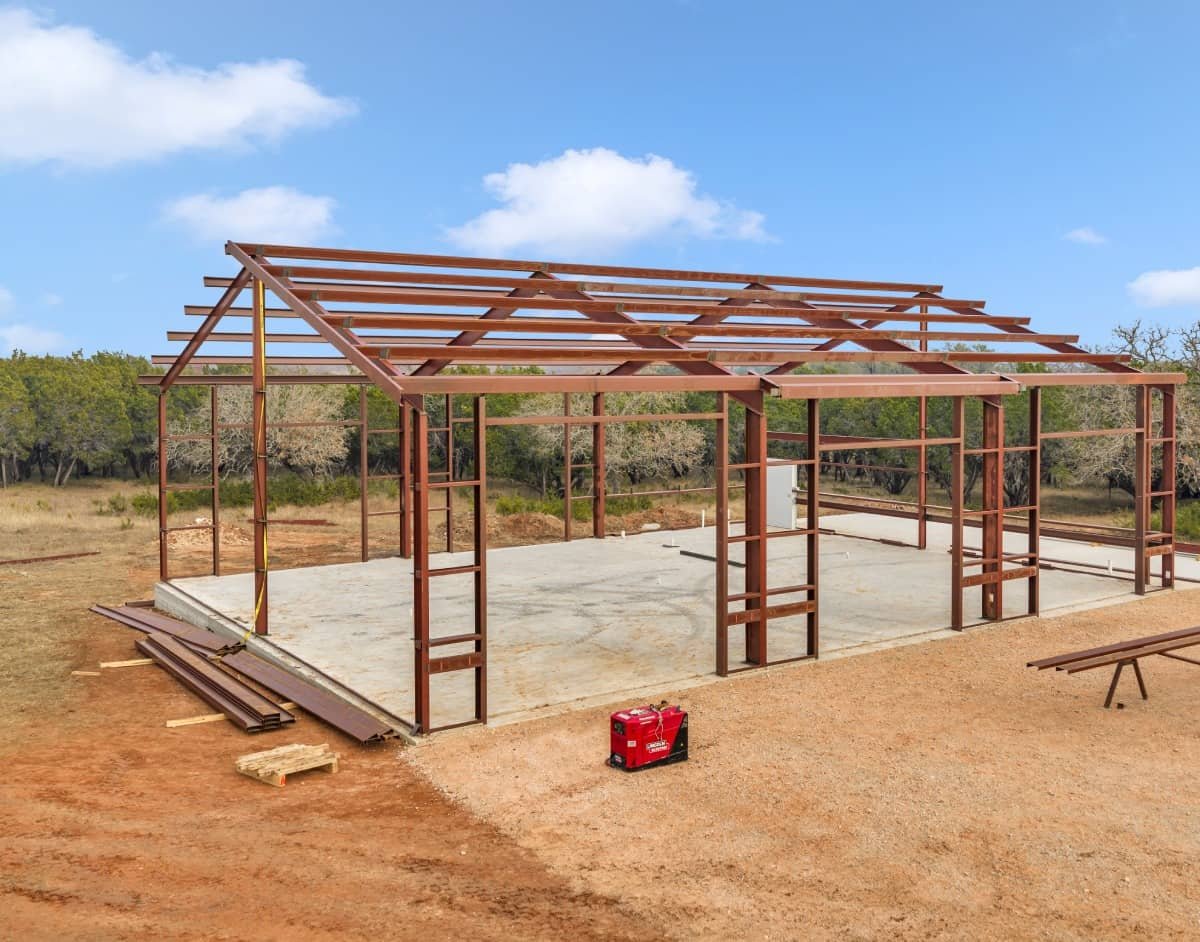
Transload and Trailer-Yard Buildings in Southern Dallas County
Trailers wait in southern Dallas County for a dock door, and a user who owns the right building gets them in and out faster. We build pre-engineered steel warehouses, transload shells and truck-shop buildings near the intermodal terminal that sits partly in Wilmer and partly in Hutchins, where freight arrives by rail and leaves by interstate. The users are not only giant distributors. They include repackagers, regional carriers, 3PL operators, parts suppliers and contractors who need 20,000 to 100,000 square feet and a yard that works.
Wilmer is on Interstate 45 and advertises easy access to I-45, I-20 and I-30; it is placed about 14 miles south of downtown Dallas. Hutchins is about 9 miles south of downtown, with I-20 and I-45 passing through it, and many of its businesses are industrial or manufacturing related. A public reference page says that after the rail operator chose Wilmer for its terminal, the city attracted household-goods, consumer and medical-supply companies. Lancaster, to the southwest, has I-35E on its western boundary, I-20 on its far north side and a business park named Park 20/35.
We look at that corridor as a place where a simple, well-priced building with good truck access beats an elaborate one.
Dock layouts and truck courts
Truck movements decide the building. We start with the number of dock doors, the door spacing and the court depth needed for the trailers you handle. A 53-foot trailer needs a long apron and a turn radius, and a deeper court takes land you might prefer to build on. We work out the balance with a drawing before any steel is ordered.
Our distribution center and logistics and fulfillment pages show typical door counts and layouts. For smaller users, a cross-dock layout with doors on two sides can move freight quickly through a narrow building; see truck terminal and cross-dock for the details.
Who builds here
The area's users include household-goods and consumer-products companies, medical-supply distributors, packaging operations and online retailers' fulfillment partners. Lancaster's employer list in its 2024 annual report includes a big-box retailer, a logistics firm, a furniture e-commerce company, a resale platform and a bottled-water company. They point to the same pattern: warehouse space with dock access and a labor pool nearby.
A smaller owner can compete in this setting with a simple building built fast. We describe the user groups on our warehousing and distribution page, and our high-bay and crane-ready page covers taller buildings for heavier industrial use.
Heavy pavement and flat ground
The land here is largely flat and open, which helps drainage and erection, but it means stormwater must be handled on site. A building with a big roof and a paved court produces a lot of runoff. We work with the civil engineer on detention, outfall and the finished floor elevation, and we plan the building pad so water drains away from the docks.
Pavement is another major item. Concrete aprons in front of docks take the worst loads, as loaded trailers stop and park on them, and landing-gear pads need extra thickness. A good base and reinforcement matter more than anything else you can do for the yard. We specify them from the geotechnical report, and we do not cut corners on subgrade.
Where the price lands
Many owners see the steel package at about a third of the total cost of a warehouse. The rest is site preparation, concrete, paving, utilities, fire protection and permit fees. In this corridor, paving and fire protection can be unusually large because of the yard and the building size. We make them visible in the quote.
Speed has value in a logistics market. A building that is ready two months sooner earns rent or revenue two months sooner. We balance the speed of a standard steel frame against the cost of overtime and expedited steel, and we tell you where speed is cheap and where it is expensive.
A realistic calendar for a warehouse
The schedule runs from permit and site work through foundation, steel delivery, erection, doors and dock equipment, and finishes. Steel fabrication is the main lead item, and dock equipment has its own lead time that is easy to forget. We order both as soon as drawings are final.
Building fast without building cheap
Logistics users want speed, and speed comes from decisions made early. We hold the design to a short list of choices: width and length, clear height, dock door count, office size and the fire protection system. Each choice gets a price. When the owner approves, we release the steel order and the foundation work together, which is how a steel warehouse beats other systems on schedule.
We also think about the second tenant. A building with standard column spacing, standard dock heights and a clean office layout can be re-leased easily if your business changes. Our pre-engineered metal buildings page describes the standard components, and the same standards make later additions straightforward, with a building addition matching the original frame.
Working beside active freight
A site next to a rail terminal and busy interstates has constant truck traffic. We plan entrances, flaggers and laydown areas so that our deliveries do not block the neighbors' trucks. Crew parking, restrooms and a fenced work area keep the job tidy and keep people out of harm's way.
On the building itself, fall protection, controlled steel lifts and daily rigging checks are routine. We inspect the anchor bolts, the bracing and the bolted connections as the frame goes up, and we call for the engineer's review if anything differs from the drawings. Dock areas get guard posts and bumpers that protect the walls from forklifts and trailers.
Neighbors
Operators near the terminal often look at Mesquite, which also hosts an intermodal facility, and at Dallas itself, where the code requirements are published by the city. We are glad to price the same building in each.
Price a building near the rail terminal
Tell us the use, the truck count and the clear height you need. We will return a concept with dock layout and yard plan, a price per square foot and a written schedule.
Common Questions
How many dock doors should a small cross-dock have?
It depends on trailers per day and dwell time. We plan the door count with you after learning your volume, then check that the apron and court can support the traffic.
Do I need to worry about stormwater?
Yes. Large roofs and paved courts shed a lot of water. We coordinate with a civil engineer on detention and outfall so the city accepts the plan.
Is steel faster than other warehouse systems?
Often, because the frame is fabricated while the foundation is built. The schedule still depends on steel lead time and permits.
Can you add dock equipment?
Yes. We coordinate levelers, seals and lights, and we order them early.