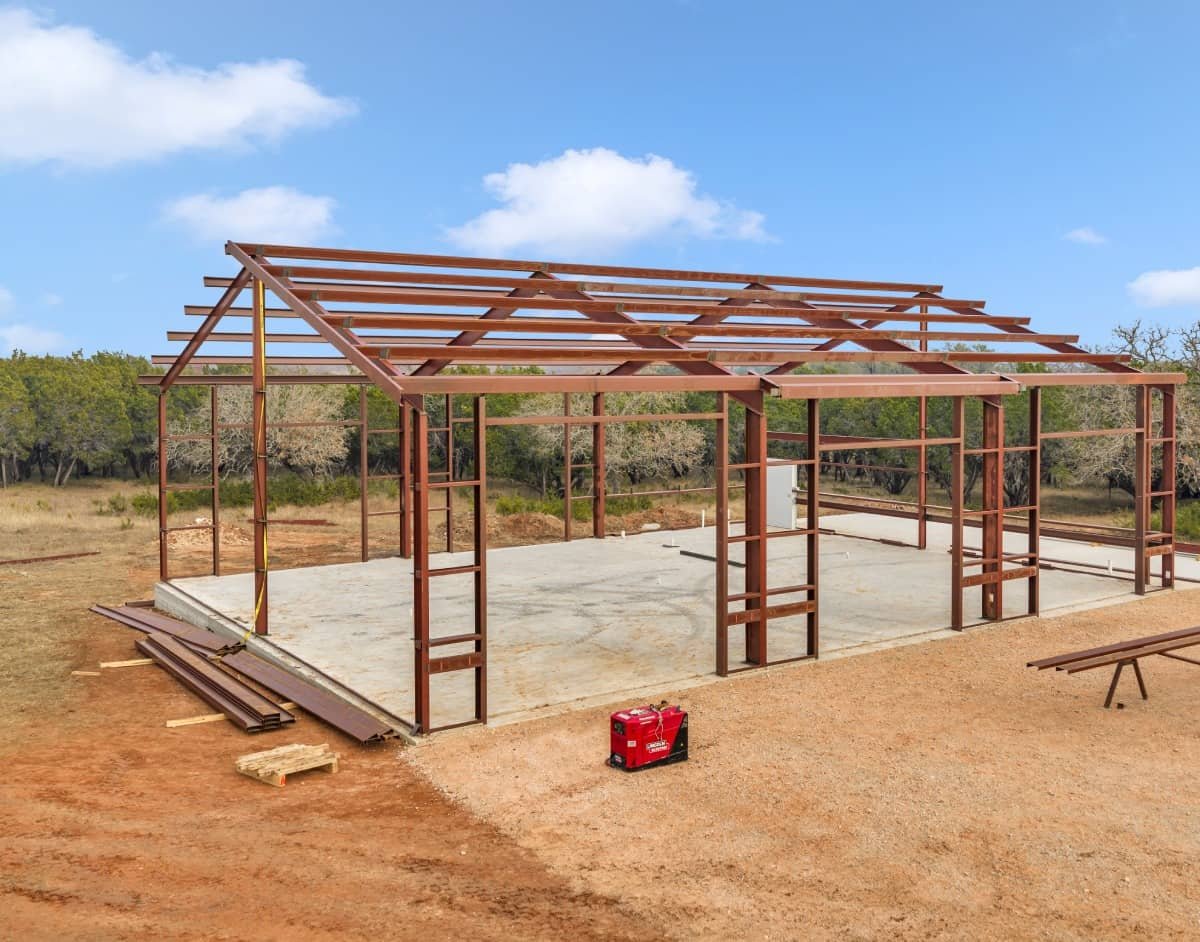
Steel Lead Times and Erection Scheduling in Deer Park, Texas
A late steel delivery in Deer Park rarely arrives alone. It usually comes with a crane booked for a day that no longer works, a concrete partner waiting on a cured slab and a customer calling about a start date. We plan the schedule so those pieces move together. Steel is ordered once the drawings are approved, the foundation is built while the frame is fabricated, and erection is booked for the week the slab is ready.
Buyers here are mostly support businesses for the industrial corridor: welding and fabrication shops, equipment and parts suppliers, trucking and trade contractors. They need a building soon, and they want a price per square foot they can trust. Steel frames are the fastest structural system for a small commercial building, and the lead time on the frame is the one number that controls everything else.
Some buyers also want ag-style storage for feed, trailers or equipment. Those buildings use the same frame with simpler interiors, and we cover them as a secondary line.
Shops, storage and flex space
The common requests are a fabrication shop with an office, a parts warehouse and a covered equipment yard. See our pages on PEMB metal buildings and truck terminals and cross-docks for typical layouts. Each is a steel frame on a slab with wall and roof panels and a set of doors sized to the use.
Deer Park is compact, at about 10.57 square miles with 10.51 of land, so lots are limited and expensive. A taller, narrower building often fits better than a wide one, and we design to the setbacks and truck turns before we pick a size.
Who we build for near the ship channel
The industrial neighbors are large. Shell Chemicals has 1,200 acres on the channel and roughly 1,500 people, while Dow holds 900 acres and roughly 700 people. A third plant, Lubrizol's specialty chemicals site, spreads over 330 acres and employs about 1,000. Those plants buy from firms that stock parts, repair equipment and haul materials, and many of those firms need a steel building.
We build for those support businesses, not for the plants. Manufacturing and automotive and fleet owners are typical buyers. Each needs a floor that takes loads, doors that match trucks and a layout that keeps work moving. We ask what you load, how often and with what equipment before we choose slab thickness, door height and the width of the truck apron.
Industrial neighbors also bring rules. Some support businesses need to meet customer safety orientation, insurance and site-access requirements before their own work begins, and the lead time on those approvals can add to a project. Owners who plan a building near the channel should ask their customers what is required, and we build the extra days into the schedule.
Retail, roads and nearby cities
The Junction at Deer Park, at Spencer Highway and East Boulevard, opened its first phase with an 83,000 square foot H-E-B and was designed for as much as 400,000 square feet of retail, as reported in November 2015. Retail growth like that supports service shops, storage and delivery firms nearby.
The Houston Ship Channel, the dredged Buffalo Bayou, forms the northern edge of the city, and La Porte lies to the south and east. Buyers often compare lots in Pasadena, Baytown and Pearland, and we price the same building on each.
Safety on active industrial roads
Sites near industrial plants have heavy truck traffic. We plan gates, laydown areas and crane placement so deliveries do not block the road. Steel erection follows strict fall-protection and crane rules, and our trade partners are held to them. We inspect bracing before panels go on, because a frame is only stable once its bracing is complete.
Neighbors need to know what is going on. We post the work hours and a phone number. If your lot lies within a plant's buffer or noise zone, we ask about extra rules early. We also keep a written daily record of who was on site, what was delivered and what was inspected, which owners and insurers appreciate when questions come up later.
What changes the price
Hurricane Harvey dropped 30 to 50 inches of rain on Deer Park in August 2017, and rainfall is heaviest from May through October. That history shapes the budget: slab height, drainage, fill and the wind package. A slab raised a foot above the expected water line costs a small fraction of the repairs after a flood. We also discuss drainage swales, culvert sizes at the driveway and where stormwater leaves the lot, since the city reviews those at permit.
Beyond site work, the big items are door count, insulation and the office. We price each as a line and show the shell cost by itself. Steel prices move, and we say so in the quote and hold the price for a stated period.
Wet seasons and schedule float
Rain can delay a pour and a crane day. We leave float in the schedule, avoid setting roof panels in high wind and sequence erection so that the frame is closed in before the next wet spell. During hurricane season we also keep a plan for securing loose steel and panels on site. If a named storm is forecast, we stop erection, secure the work and tell you the new date as soon as the track is clear.
A written window beats a single date. We give you the window, mark which dates are firm and tell you the same day when one moves.
Permits and floodplain review
The city reviews the permit set, including the site plan, foundation, wind loads and drainage, and floodplain review applies in mapped areas. We prepare the set with the engineer and answer comments. We ask early about setbacks, driveway access and any industrial-area rules. A reviewer who sees a complete set the first time usually returns comments faster, which saves days.
If a lot is near a flood zone, we design the slab elevation to the requirement and show the cost. Insurance carriers also review elevation, so we keep an elevation certificate ready.
Get a Deer Park building schedule
Tell us the lot, the use and the size. We will return a building concept, a price per square foot and a written schedule with steel, slab and erection dates marked.
Common Questions
How long is the wait for steel?
It varies with the mill and shop schedule, and we quote a window after drawings are approved. Several weeks is a reasonable planning figure. We update it whenever the supplier changes it.
Can I speed up the schedule?
Sometimes. Standard sizes and colors, quick drawing approval and a ready lot all help. Pouring the foundation while the steel is built is the biggest saving, and we do it on every job.
What if a storm delays the pour?
We leave float around the pour and the erection. If rain or wind pushes the slab, we rebook the crane and tell you the new date.
How high should the slab be?
Above the expected flood level for your lot, with a margin. The floodplain administrator can tell us the requirement.
Can you build ag-style storage?
Yes. A barn or equipment shed uses the same frame with different doors and floors. We price it as an agricultural building.