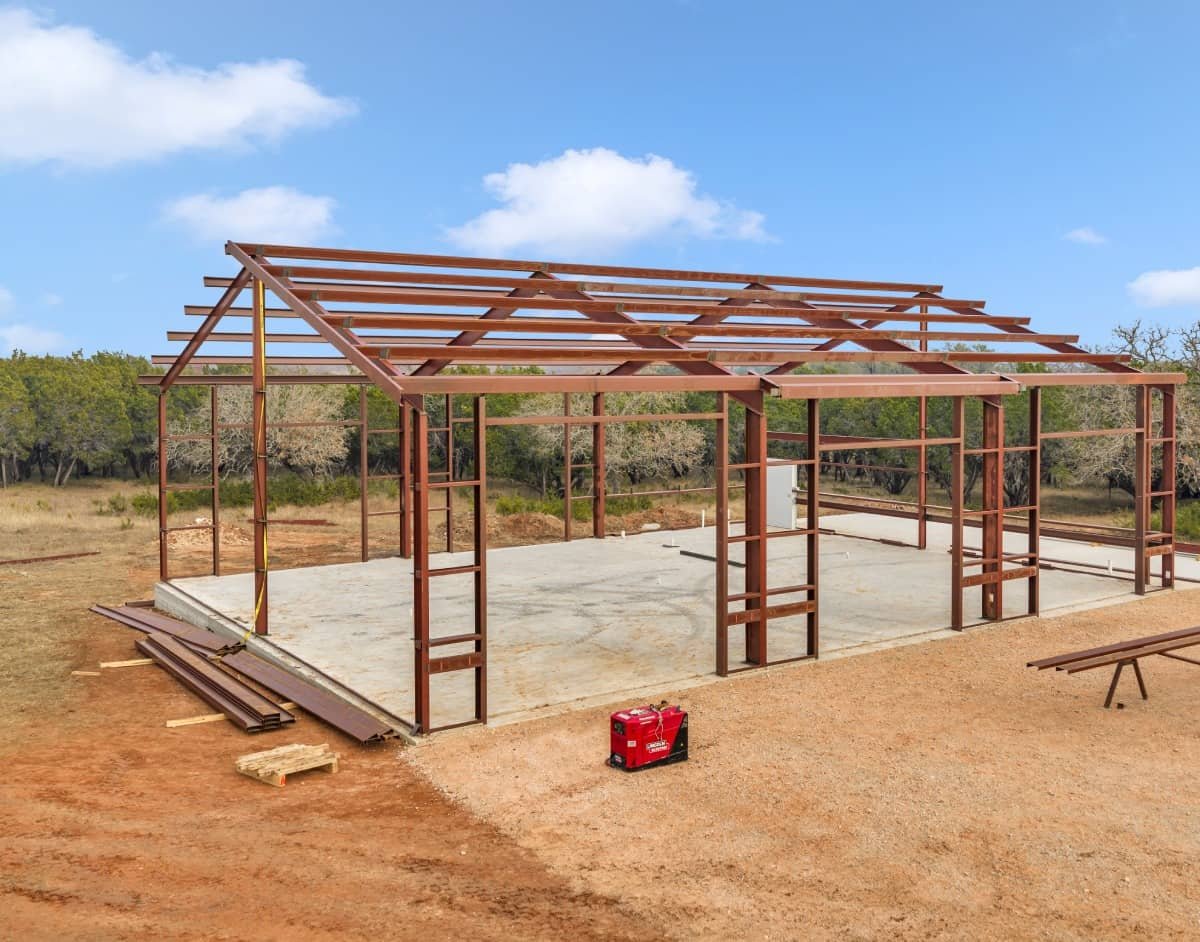
Hangar and Airport Steel Buildings in Bedford, Texas
Owners who base an aircraft near Bedford want a hangar that opens easily, keeps weather off the wings and does not cost more than the airplane's annual upkeep. We design and build steel hangars, shared hangar rows, maintenance bays and airport shops, and we explain the door, the floor and the clearances in plain terms before anyone signs.
Location helps. State Highway 121 and State Highway 183 both serve the city, and SH 183 is also called Airport Freeway, which tells you something about how the area developed. Heavy steel trucks and the cranes that set frames reach most sites quickly. Bedford covers roughly 10.04 square miles in the Mid-Cities area of northeastern Tarrant County at an elevation of about 600 feet, and it shares borders with Hurst and Euless, so lots are mostly infill and small.
Small lots shape hangar design. A hangar needs a wide door, a clear apron and room to move an aircraft, and a tight lot can restrict all three. We start with a site test fit that shows the door swing, the tow path, the setbacks and the fire lane. If the lot is too tight for the airplane you have in mind, we say so before you spend money on drawings.
Foundation, frame, door, finish
The sequence is short. Foundation, frame, panels, door and finish are the steps, and each has a date and a responsible trade partner. We schedule, coordinate, supervise and inspect the partners, and we serve as your single point of contact.
We ask about the aircraft first: wingspan, tail height, weight and how you will move it. Then we ask about the use, which might be storage only, a small shop corner or full maintenance with a lift and fuel. Those answers set the eave height, the door type, the slab and the power. A single-airplane hangar with a few outlets is simple, while a shared hangar needs partitions, separate meters and fire separation between bays. See our aircraft hangars page for typical layouts.
Safety near flight paths and shared ramps
Cranes and tall steel near an airport can affect flight paths, so we check height limits and coordinate lifts with the airport manager. We mark the crane, avoid lifts during busy hours and keep vehicles off active taxi routes.
Trade partners follow lifting and fall protection rules, and we inspect bolt torque, bracing and door tracks before panels are installed. Fuel, paint and welding in a hangar add fire concerns, so we confirm the fire protection the city and the airport require before the building is occupied.
Hangar fires are serious because of fuel, solvents and batteries, so storage rules matter. Keep fuel in approved cans and cabinets, keep a clear path to each exit, and do not block extinguishers with tool carts. We go through the layout with you at handover and note where each safety item belongs.
What a hangar costs and why
The door is the biggest single driver on a small hangar. A bifold or hydraulic door can account for a third or more of the shell price, and a wider door costs more than a narrow one. Floor finish, insulation, heat, lighting and electrical come next.
The slab matters too. It must be flat enough to roll an airplane and slope enough to drain. Radiant heat or a sealed coating are options. We price each item separately, so you see how decisions move the total. Ask every builder to price the same door and the same wind rating before comparing.
Operating cost is worth a thought. An insulated roof and walls cut heating and cooling bills if you work inside, and a light interior color improves visibility at night. Gutters keep runoff from the apron edge. These items cost little at the start and are tedious to add later.
What a hangar package includes
A package lists engineered drawings, the frame, wall and roof panels, trim, the door, the slab, basic lighting and erection. Insulation, an office corner, a restroom, a mezzanine and fuel storage are options. Our overhead hangar doors page explains how doors are chosen.
Airport approval, civil work, utilities, paving and special inspections may be inside or outside the price. We mark each one clearly. Delivery timing depends on steel lead time, and the door package often has its own lead time, which we state at signing so the date is real.
Electrical is another item hangar owners overlook. Door operators, lights, outlets for tools, battery chargers and a possible heater all pull power, and the service size and meter location depend on the utility. We ask for a one-line list of the equipment and then size the panel, so the first quote includes what you will need.
Pilots, flight schools and the companies around them
Private pilots, flight schools, charter operators, mechanics and corporate flight departments are the usual buyers. Our aviation industry page explains the process. Texas Health Resources is the largest Bedford employer in the 2023 financial report, with 1,480 employees, and large employers like that attract business travel and medical flights.
Bedford Commons is a venture of the city and Midway Development Group, LLC, listed in the FY 2024-2025 budget highlights, on land near Bedford Road and L. Don Dodson Drive, with townhomes, restaurant and retail pads and a lake with lawn space. New projects like that tighten schedules for concrete and steel trades, so we book partners early.
Related building work
Hangar owners often add a shop corner, an office or a storage building. Our aircraft hangar building type page shows common layouts, and a separate storage or equipment building can follow the same frame. Comparing sites in Irving, Arlington and Bedford is easy when we price the same design in each.
Steel lead time deserves a note. The frame and the door each take time to produce, and the later of the two sets the earliest erection date. We give both dates at signing and update them weekly, since a hangar often has a lease or an insurance renewal tied to its opening.
Plan your Bedford hangar
Send us the aircraft, the airport and your target date. We will return a concept, a price per square foot and a steel lead time.
Common Questions
How wide should the hangar door be?
Wingspan plus generous clearance on both sides, and more if you tow by hand. We measure your airplane and recommend a width.
Which door type is best?
Bifold doors are economical. Hydraulic doors are smooth and seal well. Sliding doors suit wide openings. We compare them for your wingspan and budget.
Do I need airport approval?
Usually yes, for height, setbacks and access. We ask for the airport rules at the start.
Can I add a shop corner or office?
Yes. Insulation, heat, a separate room and power are options. Decide early so the slab and wall framing are set correctly.
Can I share a hangar with a neighbor?
Yes. A shared hangar needs a partition, separate power meters and a fire plan, and the airport may have rules on use. We draw the layout and price each bay so costs are clear to both owners.
How long does the steel take?
The frame and the door each have a lead time. We state both at signing and plan the slab to be ready.